
Boston – A study initiated by the Norwottuck Network to assess the benefits of the completion of the Massachusetts Central Rail Trail (MRCT) system predicts that general health and wellness would improve, and annual trail usage could quadruple, creating opportunities for overnight visitation, new jobs, increased local small businesses and an overall economic benefit ranging from $87 to $182 million annually.
The Norwottuck Network, a nonprofit, raised $75,000 to commission the study by Kittelson & Associates, Inc. of Boston and Cambridge Econometrics of Northampton to evaluate the potential use and health and economic benefits of completing the 104-mile, multi-use bicycle and pedestrian trail system that runs east-west between Boston and Northampton along the historic Massachusetts Central Railroad corridor.
Findings outlined in “Envisioning a Statewide Connection: Mass Central Rail Trail Benefits Study,” released in mid-May, indicate that completion of the trail would result in increased usage of up to four to five million people annually and reduced health costs from $4.1 to $5.8 million per year. On the economic side, a completed trail would create $87 to $182 million per year in new economic activity, including $55 to $114 million in new spending by trail users and up to 1,250 new jobs.
Leaders of the nine-member Norwottuck Network board, founded in 2000, will now ask the state Department of Transportation (DOT) to evaluate construction costs and create a timeline for completion.
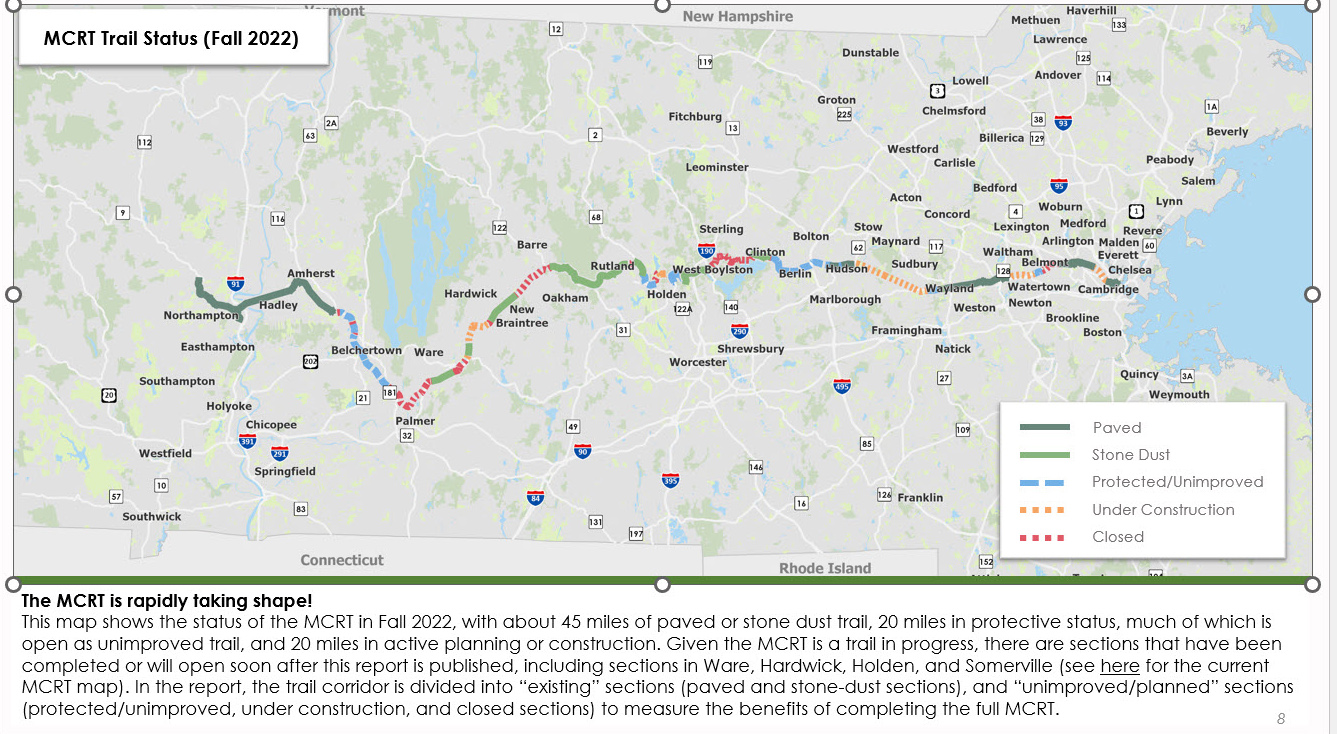
MCRT map
Currently, 55 miles of the trail are officially open with roughly 20 miles in the planning or construction stages. Challenging sections of the trail to be completed include areas where bridges are missing, trail segments that will need to be purchased from private owners and repairs to a 1,000-foot tunnel near the Wachusett Reservoir. A completed Mass Central trail would eliminate those barriers and open those sections, and also link the rail trail system to 18 additional, existing and under-development rail trails, creating a 273-mile trail network within the state of Massachusetts.
Craig Della Penna, president of the network board, said the DOT recently conducted a study to evaluate the feasibility of reassembling segments of the Mass Central Rail Trail into a unified trail system and released findings in 2021; no action was taken because the benefits had yet to be assessed. “This report is the next step,” Della Penna said. “And we are not surprised by these findings. These long walking and biking trails produce a lot of benefits. The question was, ‘Is it worth spending public money?’ This report unequivocally says yes, it will be worth it.”
Kittelson & Associates noted that the completed network would be within 10 miles of 64% of all Massachusetts residents and would offer a boost to 19 cities and towns defined by the consultants as Gateway Communities—those that face social and economic challenges but retain assets such as infrastructure or major institutions. These Gateway Communities would benefit: Barre, Billerica, Clinton, Easthampton, Hardwick, Hatfield, Lunenburg, Marlborough, New Braintree, Oakham, Palmer, Saugus, South Hadley, Southampton, Southwick, Ware, Warren, West Boylston and West Brookfield.
As part of its study, Kittelson & Associates surveyed current Mass Central Rail Trail users, receiving responses from over 2,000 participants. These are among the findings:
- If the trail was completed, 26% of current users would use the MCRT for shopping; 16% to commute to work; 5% to commute to school; and 86% to access parks and other features.
- Ninety-three percent of respondents anticipate using the MCRT more frequently and traveling on the trail for longer distances.
- Almost 50% would take a multi-day trip.