
by Jennifer Martel
Springfield’s historic Court Square is undergoing a notable transformation, embracing environmental sustainability, and ensuring inclusivity for all as part of the city’s forward-looking initiative to revitalize downtown through public realm improvement projects.
Downtown Springfield boasts an authentic arts and culture scene, vibrant nightlife, expansive riverfront, and full slate of public outdoor events set against a backdrop of historic charm. Despite its allure, economic development has been a challenge. In 2019, the city hired the Chicago Consultants Studio, Inc. (CCS) to craft a master development plan for a new destination district around two key anchors, MassMutual Center and MGM Springfield, which called for open space revitalization to cohesively enhance and link the downtown experience. CCS then enlisted Copley Wolff, a Boston-based landscape architecture firm, to create the Court Square Public Realm Master Plan. The plan detailed a phased approach to implement improvements aimed at activating the untapped potential of the area which includes amenities and attractions like Pynchon Park, Symphony Hall, the Old First Church, and of course, Court Square Park.
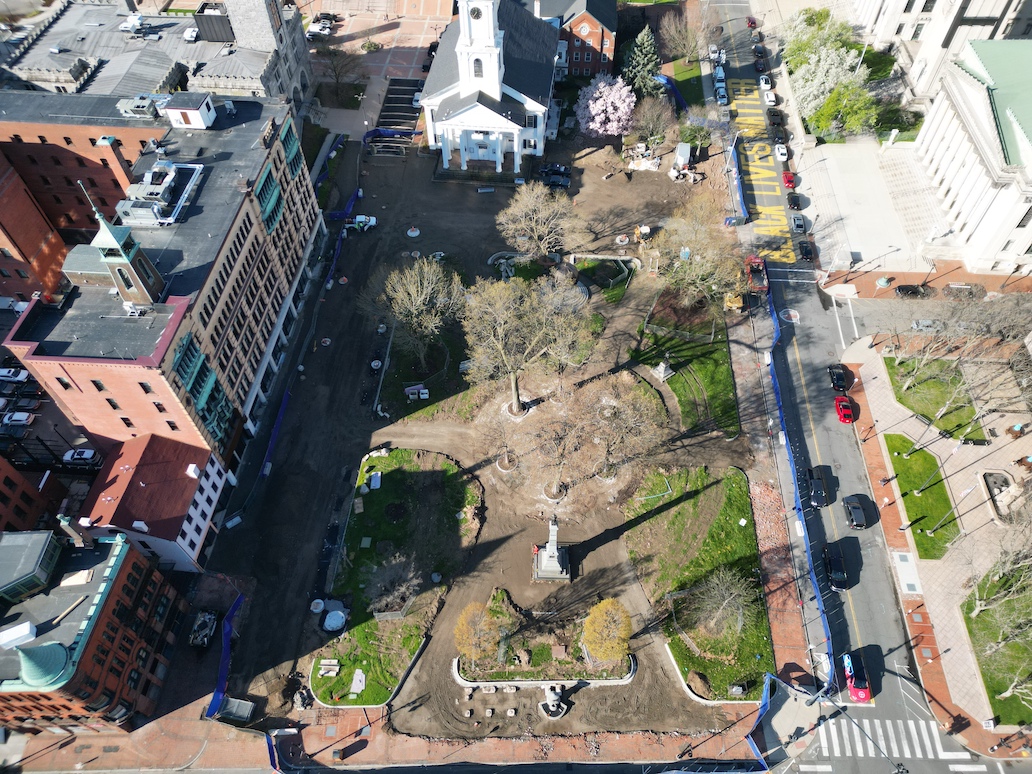
The first phase of the master plan, currently underway, focuses on the renovation of the historic park and surrounding streetscapes. Serving as the heart of the city since settlement, Court Square Park holds immense historical significance. While the community expressed a desire to preserve its character, improvements to accessibility, materiality, and stormwater management were deemed essential for it to thrive as a modern urban destination.

The renovation balances preservation of heritage elements and integration of modern amenities. Brick pathways, decorative fountains, and majestic trees are being rejuvenated, while new additions such as permeable pavement enhance stormwater management. Crucially, the entire site is being re-graded to ensure inclusivity for individuals of all abilities, with new paved areas facilitating access to the square’s numerous monuments.
Beyond the park, surrounding streets, sidewalks, and plazas are undergoing extensive reconstruction to improve connectivity with nearby retail establishments, offices, and institutions. Modern paving materials, lighting fixtures, and site furnishings are being deployed to ease the transition between the historic palette and the evolving developments surrounding the site. A new event plaza will set the stage for the city’s vibrant array of outdoor programming, festivals, and events throughout the year. A notable highlight of the project is the creation of a new shared-access street, designed to support vehicular access to the recently opened 31 Elm, an adaptive reuse development housed in the historic Court Square Hotel.
Construction in this historic district has presented a multitude of challenges. The project civil engineer identified a combined sewer system which required separation. Archaeologically significant areas demand meticulous oversight, while the preservation of existing trees necessitates specialized excavation and transplantation techniques. Unforeseen subsurface conditions have also emerged, prompting agile responses and adaptive redesigns to overcome obstacles.
Despite these complexities, the project remains on track for completion by mid-summer, just in time to welcome residents and visitors alike to a rejuvenated Court Square, poised to reclaim its status as a vibrant cultural hub for the city.

Jennifer Martel
Jennifer Martel, ASLA, PLA is principal at Copley Wolff Design Group, Inc.


