Bryan Northrop, executive vice president and general manager at Skanska USA Building’s New England region, and Paul Pedini, senior vice president for Skanska USA Civil’s New England region, share their outlook on the construction industry for 2025.
Need for More Workforce Development in 2025
by Bryan Northrop
Looking ahead to 2025, one of the most pressing issues facing the construction industry is the shortage of skilled labor, with both craft labor and white-collar construction management teams. While this has been a persistent challenge in the industry for the past few years, it is intensifying as more experienced professionals retire.
As reported in the Boston Globe, there are approximately 6,000 students in Massachusetts on a wait list for vocational schools as our current infrastructure is unable to meet the demand. In addition, students are not often encouraged to consider a career path in construction as there is a general lack of awareness of the various career paths within the construction field and how rewarding a career it can be. In 2025, we hope that there can be a renewed focus on education and outreach to this next generation of potential construction workers, and that industry professionals interacting with them emphasize the rewarding opportunities available to them if they decide to join the industry.
Turning to the issues of construction costs heading into 2025, while material prices have generally reached a stable point, labor costs continue to rise which will ultimately trickle down to companies looking to build. This will force contractors such as ourselves and project owners to navigate tighter budgets and get creative in order to maintain budgets.
As for construction trends, moving into 2025 we expect the local interest in sustainable design and decarbonization construction measures to grow and gradually become the new standard. This will include an increased focus on geothermal and solar energy, as well as initiatives surrounding adaptive reuse and resilient materials. The greater adoption of these technologies and practices will allow companies such as ours to better help clients and partners achieve their sustainability goals, which will ultimately enhance the sustainability and efficiency of our cities.
Construction Firms to Become More Selective and Strategic in Project Selection
by Paul Pedini

I-95 15 project
2025 will be an incredibly busy year for our Civil operations in New England given the construction industry is currently experiencing one of the most robust economic times for infrastructure. Skanska recently commenced on the I-95 15 project in Rhode Island. It is the largest project we’ve ever built in New England. There are three projects bidding in the Boston area in the next few years valued between $1 and 2 billion each. We must be selective when assessing the other smaller jobs, so we have the bandwidth to take on one of these large projects.
At Skanska, we have always taken a pragmatic and selective approach when it comes to the projects we commit to, and this will only intensify as we evaluate our ability to deliver with the resources we have.
The future of the construction industry is currently being shaped by a dual challenge: the increasing cost of labor as well as materials. There are of course lingering effects from the COVID-19 pandemic – material costs spiked which exceeded initial engineering estimates, creating financing issues for projects. Now, with an incredible spike in infrastructure projects, there’s a second wave of price increases taking place. This underscores the importance of having a strategic and intentional approach to selecting projects to best navigate current market dynamics effectively.
As the capacities of the infrastructure companies dwindle, owners are concerned that they will get enough bidders on their projects. Never before has strategically targeting jobs for pursuits been as difficult as it is now.
Alternate delivery is currently the preferred procurement model in the U.S. A majority of our projects are best value procurements. They include design build, progressive design build, and CM/GC. These procurements are not necessarily awarded to the low price, but rather to the company that provides the best combination of tech and price.
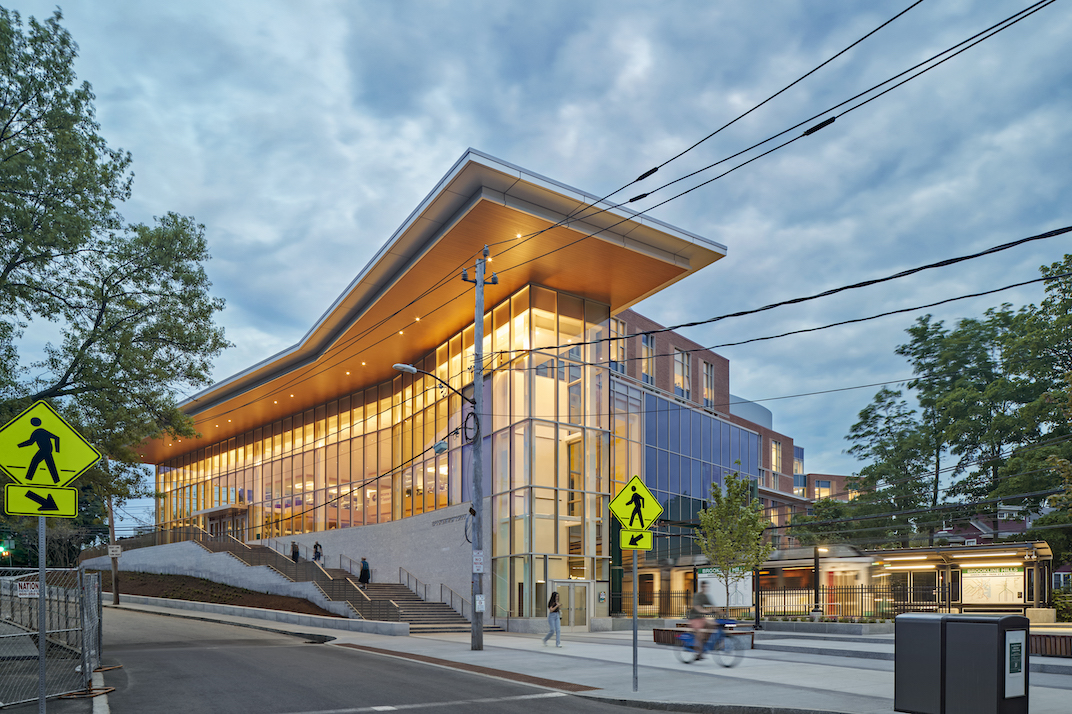
Skanska’s Civil and Building teams worked together on the Brookline High School Expansion Project in Brookline, Mass. / Photo by Robert Benson Photography
We use our VDC (virtual design and construction) group in Waltham to create a better way to build the job for projects across the U.S. Owners employ best value contract models to reduce their risk. We use technology to construct the job virtually before doing so in the field. This significantly reduces our risk and the likelihood of financial loss on a project.
We are collaborating with our design engineering subcontractor on the design of our $625 million design build I-95 15 job in Rhode island. This marks the first time a designer is working with the contractor in the same 3D model on a DOT job in New England. This helps ensure fewer surprises with quantity scope creep and unforeseen design issues than has been common on past construction projects.
OneSkanska is also proving to be a great asset. Skanska is the only company in New England who is vertically integrated – capable of taking on projects which feature significant building and infrastructure components. This has proven to be a valuable asset, providing owners with an option where they can deal with one company to manage such jobs, as opposed to hiring a consortium of firms who have not previously worked together.