
by Sarah Vaughan and Patrick Murphy
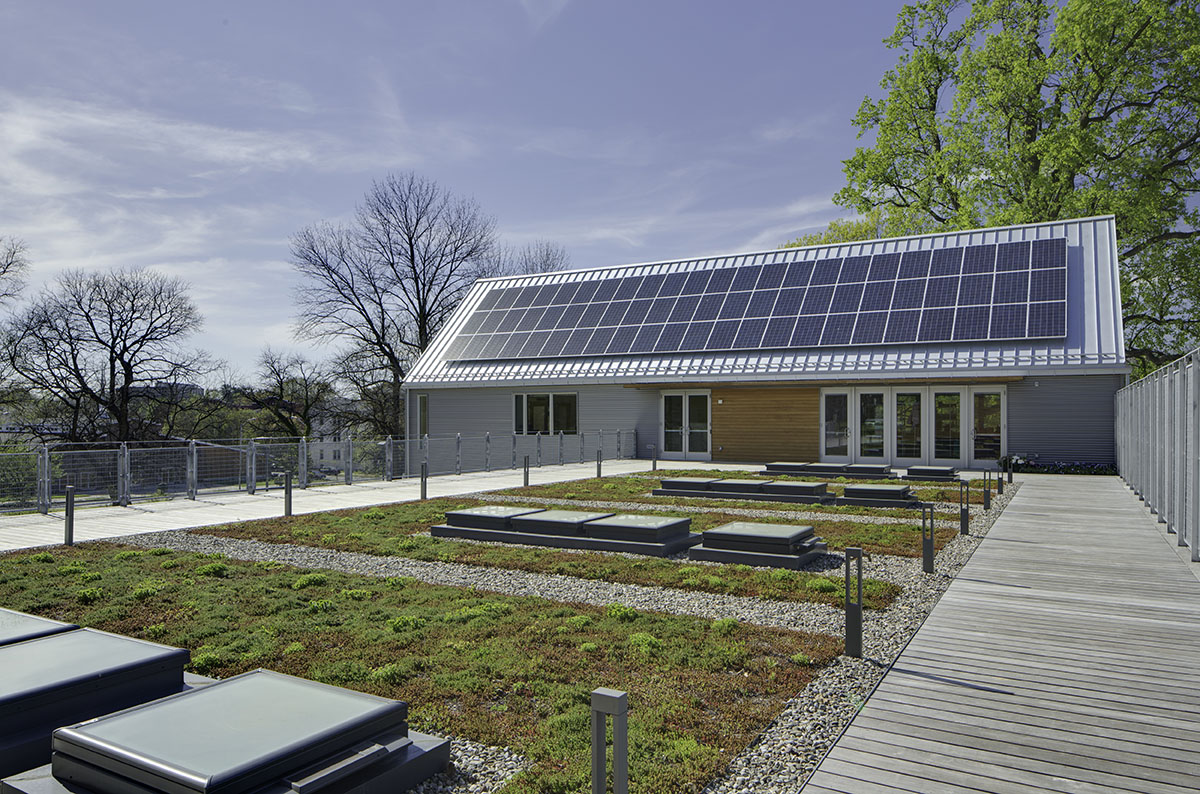
Photo by Karl Connolly Photography
With the ever-visible effects of climate change and the rising costs of utilities, design professionals are being asked, “How can my building achieve net zero energy?” This question is increasingly common when designing schools. To achieve net zero energy, the amount of renewable energy generated on site must meet or exceed total annual energy consumption.
Schools are prime candidates for net zero energy design for many reasons. Often the peak occupancy and peak weather conditions do not occur at the same time. Schools are designed for longevity with robust construction and systems. These buildings benefit from a design which reduces the operational costs. Buildings that can support themselves are resilient to power disruptions. Most importantly, schools can represent the best in a community and reflect its values to promote sustainability and address climate change. A school can help contribute to a better world that the students will inherit.
The path to net zero energy can be practical and cost effective. First, the design team and owner must drive down the overall demand of the building significantly. Then system design should be optimized to maximize energy efficiency. It is critical the design team push steps one and two as far as possible before finally offsetting with renewable energy.
Passive strategies effectively reduce the loads of the building in the early stages of design. Using computer modeling simulations, the building’s orientation, massing and shading can be optimized to minimize loads (and HVAC/electrical capacity). Modeling can also be used to help design the building to encourage daylighting and natural ventilation, which reduce energy consumption and improve wellness.
Once passive strategies have been used, further reduce energy demand via active strategies including high performance envelope and/or thermal mass design, efficient lighting and controls, efficient kitchen design, heat/energy recovery and equipment/plug load reduction. As building system energy falls and as classrooms utilize more technology, plug loads become a larger portion of overall energy use; design teams and owners should focus on plug load reduction to make that final leap to achieving net zero energy.
Next, optimize system design during early design using energy modeling to select HVAC systems to maximize energy efficiency. Schools, particularly in Massachusetts, are now adding cooling energy to address year-round occupancy and rising ambient temperatures. This creates an opportunity to more effectively utilize ground source heat pumps, to store the heat rejected from the building in the summer, in the earth for use in heating the building in the winter. Dedicated outside air systems coupled with local heating/cooling systems such as chilled beams and radiant floors/ceiling panels can be applied strategically to reduce energy consumption. For high occupancy spaces, ventilation rates may support an all-air VAV system with smart building controls. Systems should be zoned by program type and operational schedule as much as possible to maximize setback savings potential. The building management system can leverage occupancy sensors and setpoint reset strategies, so HVAC and lighting systems react to actual building usage and control to demand in real time.
Once the building has been designed to be as energy efficient as possible, renewable energy can be introduced to offset the energy consumption. Although this is the last step, the design team must be thinking ahead to find the best fit for renewable sources. Geothermal systems require an area outside for the well field, and solar thermal hot water systems require roof space and structural support. Photovoltaic arrays can be installed in a variety of configurations including on the roof, site, or covered parking. All scenarios require careful planning and coordination with architectural, structural, electrical and landscape design teams.
Schools are a unique building type where a net zero design has dual benefits: reducing utility costs while also engaging the community in sustainability and energy efficient building design. The path to NetZero for design professionals to help achieve the project goals starts in the earliest stages of design. The key is to design the building to reduce overall energy demand as much as possible. Then use modeling to help inform design and select optimal systems. Finally, introduce renewable energy sources and harness nature to power your building.

Sarah Vaughan

Patrick Murphy
Sarah Vaughan, PE, LEED AP BD+C and Patrick Murphy, PE, LEED AP BD+C are with Vanderweil Engineers Inc.


