
by Christopher Broyles
MassDEP recently proposed new stormwater regulations aimed at bolstering resilience to flooding and incentivizing the use of nature-based solutions. These changes will have significant impact on new and redevelopment projects. Here are four critical elements of the proposed new regulations that we believe design teams should pay particular attention to.
New Rainfall Benchmarks
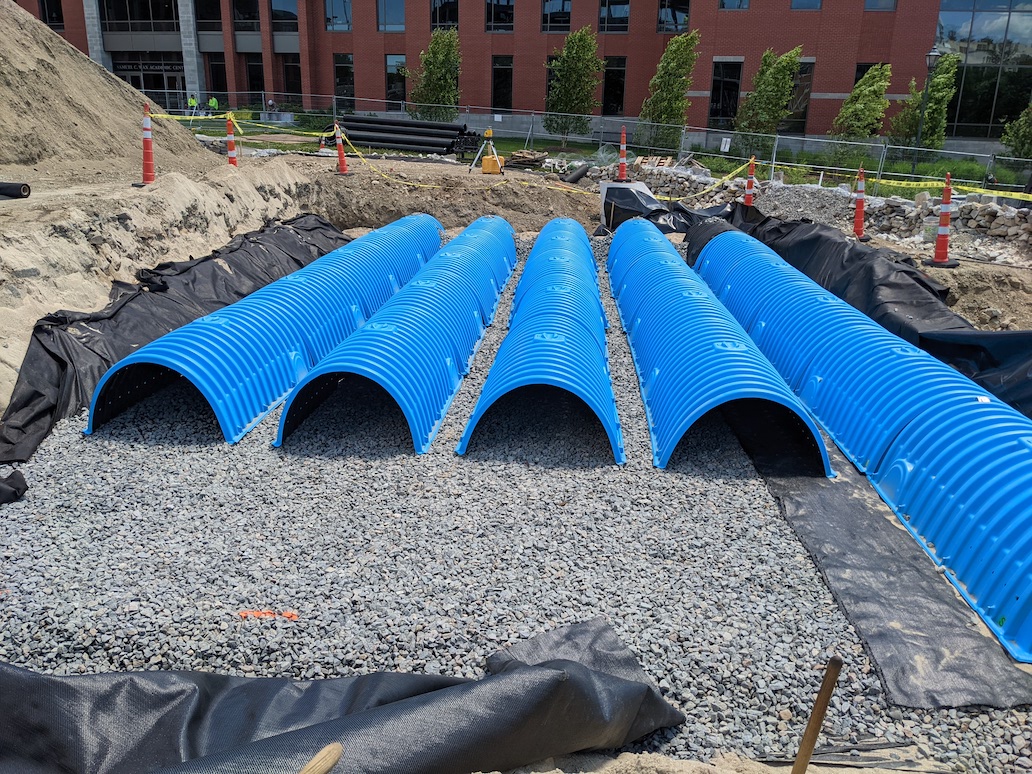
Up until now, rainfall estimates were based on data from 1961. Under proposed amendments (pending approval) to the Wetlands Protection Act (310 CMR 10.00), that would be updated to rainfall estimates based on 2019 National Oceanic and Atmospheric Administration (NOAA) data. As climate change has increased significant precipitation events, the practical impact of this shift for developers would be a need to design for larger volumes of water, from larger pipes to more and/or larger stormwater facilities, such as surface stormwater basins and underground chamber systems. Some municipalities, agencies, and developers have already been preparing for greater stormwater volume; under the amended regulations, those who have not will be required to do so.
A New Groundwater Recharge Requirement
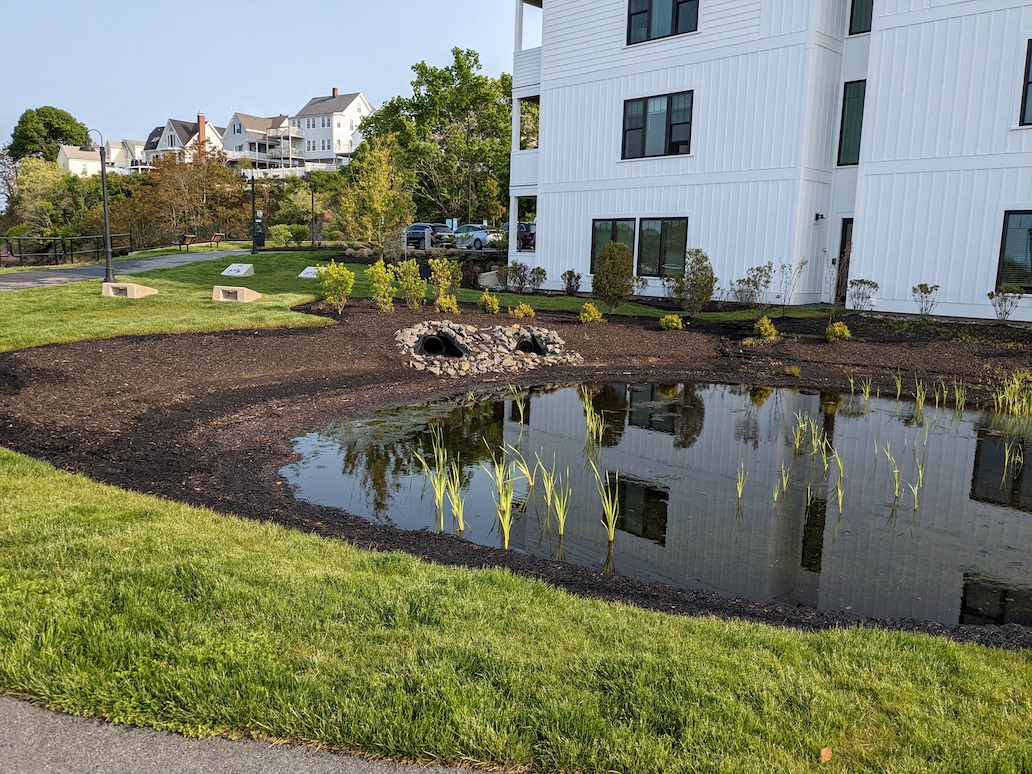
Rain garden collecting and filtering stormwater after a recent storm event
A second proposed change would increase the required amount of groundwater recharge, which can happen via the natural downfall of water into the earth during storms and/or by human-built systems to divert stormwater into specified areas. In Massachusetts, developers or organizations who pave an area must balance out the lost groundwater recharge due to the impervious surface by storing that same volume of would-be groundwater elsewhere on the site in an amount equal to half an inch across the paved surface area. To protect against drought-based problems, the new requirement would increase that groundwater recharge requirement by twofold, for a mandated one inch across the paved surface. As a result, new site development projects will need to consider more and/or larger groundwater systems, and in many cases, permeable ground surfaces may become more attractive.
Changes to Sediment and Pollution Requirements
Another proposed change relates to the amount of total suspended solids (TSS) – sand, silt, etc. – that must be removed before water may be discharged from a stormwater facility. Currently, facilities must have an 80% TSS removal rate. To protect waterways from runoff, the new regulations propose raising that requirement to 90% of sediment. In addition, proposed changes include a new regulation: the total and documented removal of phosphorus. Many stormwater facilities already achieve this through chemical or biological treatments (or both); under the proposed changes, facilities would now be required to comply with and document this process. A similar compliance and documentation proposal extends to any contributions to a body of water’s total maximum daily load (TMDL), which is the maximum amount of a pollutant permissible in a body of water while still meeting water quality standards.
New Credits for Low-Impact Development (LID) and Environmentally Sensitive Site Design (ESSD)
Some costs associated with adhering to these new requirements may be offset by a proposal to offer seven new credits for those who implement LID or ESSD practices. Examples include protecting or enhancing tree canopies and buffer areas, reducing impervious surface areas, strategically directing runoff, and incorporating environmentally sensitive site design. While these priorities are not new, the proposed changes would give them “teeth.” Until now, implementing these measures resulted in little more than a “pat on the back” from DEP. Under the proposed changes, adopting and documenting these actions would yield credits that can mitigate a developer or owner’s requirements in other areas.
Additional new standards for Land Subject to Coastal Storm Flowage (LSCSF) intend to reduce damage to properties, infrastructure, and the natural shoreline by preserving and restoring natural floodplain functions of impacted area(s). Read more about this element and review the key takeaway briefs at https://www.meridianassoc.com/In-Sites/new-massachusetts-stormwater-measures-are-coming-top-takeaways-for-developers-and-municipalities.

Christopher Broyles
Christopher Broyles, PE is a project manager at Meridian Associates, Inc. He can be reached at cbroyles@meridianassoc.com.


