• Twitter
  • Facebook
  • Instagram
  • Linkedin
  • YouTube
  • RSS
  • Sign In
  • My Account
High-Profile MonthlyThe Source for AEC Industry News
  • All News
      • Up Front
      • Groundbreaking
      • Topping Off
      • Ribbon Cutting
      • View All Up Front Stories
      • StMarysBank_NorthBranch_ToppingOffNorth Branch Construction Celebrates Topping Off for new St. Mary’s Bank Branch
      • Special Features
      • Contributor
      • Green
      • J.E.D.I.
      • Mechanical / Electrical / Plumbing (MEP)
      • Vision
      • Women In Construction
      • Regions
      • Connecticut
      • Northern New England
      • Popular Sectors
      • Cannabis
      • Corporate
      • Education
      • Healthcare
      • Interiors
      • Landscape/Civil
      • Life Science
      • Multi Residential
      • Restoration/Renovation
      • Retail/Hospitality
      • Senior/Assisted Living
      • Technology & Innovation
      • Other News
      • Awards
      • Community
      • COVID-19
      • Mixed-use
      • Municipal
      • National/International
      • Organizations and Events
      • People
      • Philanthropy
      • Products and Services
      • Real Estate
      • Training and Recruitment
  • Subscribe
  • Next Issue
  • Archive
  • Advertise
  • Podcast
  • A/E/C Associations
  • Calendar
High-Profile Monthly
  • All News
      • Up Front
      • Groundbreaking
      • Topping Off
      • Ribbon Cutting
      • View All Up Front Stories
      • StMarysBank_NorthBranch_ToppingOffNorth Branch Construction Celebrates Topping Off for new St. Mary’s Bank Branch
      • Special Features
      • Contributor
      • Green
      • J.E.D.I.
      • Mechanical / Electrical / Plumbing (MEP)
      • Vision
      • Women In Construction
      • Regions
      • Connecticut
      • Northern New England
      • Popular Sectors
      • Cannabis
      • Corporate
      • Education
      • Healthcare
      • Interiors
      • Landscape/Civil
      • Life Science
      • Multi Residential
      • Restoration/Renovation
      • Retail/Hospitality
      • Senior/Assisted Living
      • Technology & Innovation
      • Other News
      • Awards
      • Community
      • COVID-19
      • Mixed-use
      • Municipal
      • National/International
      • Organizations and Events
      • People
      • Philanthropy
      • Products and Services
      • Real Estate
      • Training and Recruitment
  • Subscribe
  • Next Issue
  • Archive
  • Advertise
  • Podcast
  • A/E/C Associations
  • Calendar
Contributor • Multi Residential • Senior/Assisted Living • Trends and Hot Topics

Thoughtful Design Solutions Makes a Difference in Senior Living Environments

April 29, 2016
by  Nicole M. Owens and Myles R. Brown
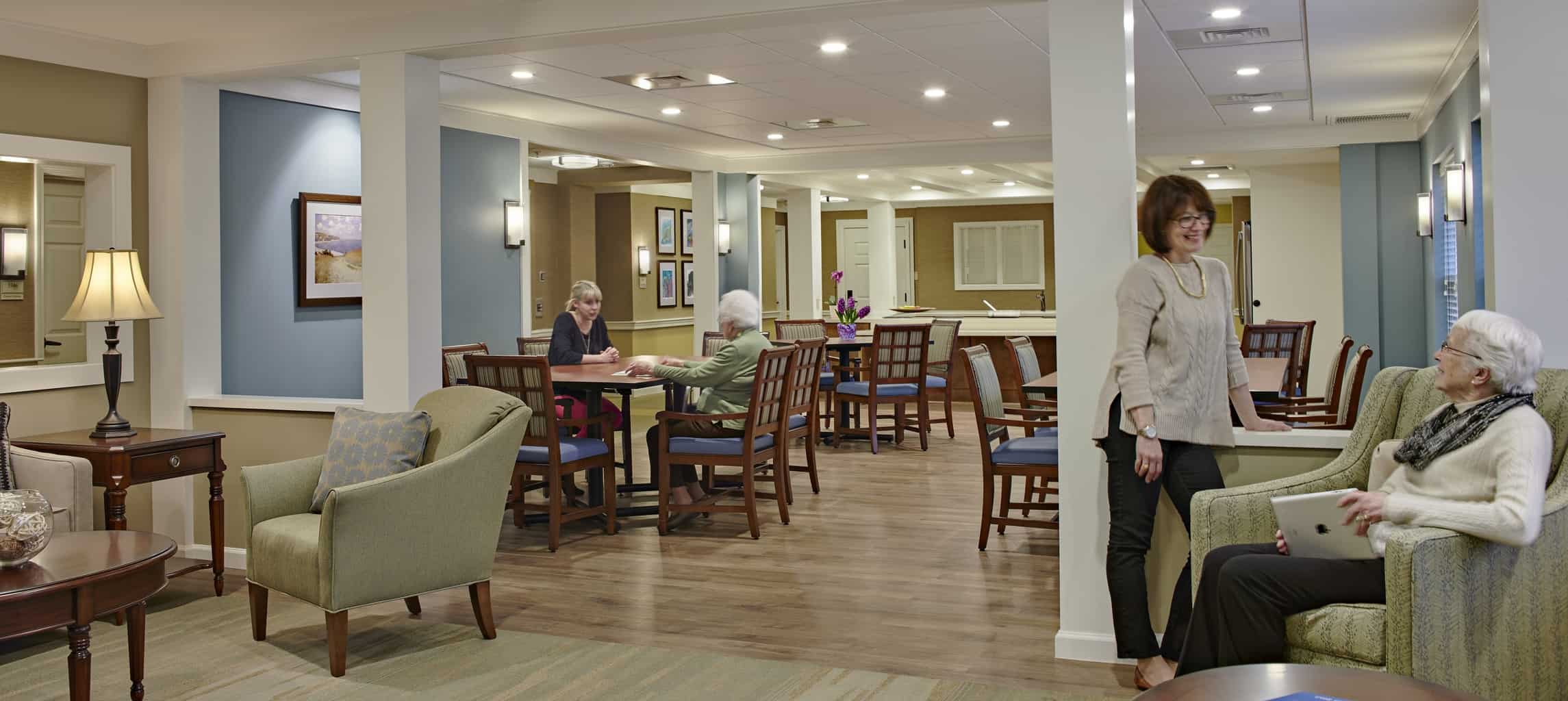
Kitchen & Living Room area_AE_CVOC_02 2

Kitchen & Living Room area

By 2050, the number of senior Americans with Alzheimer’s, or some other kind of dementia, is estimated to reach 13.8 million, triple the number affected today. Two senior living communities in Connecticut, which provide care to residents with memory challenges, are leading the way medical research influences thoughtful design solutions. Healthcare professionals say it is making a difference. While Covenant Village of Cromwell and Duncaster Retirement Community in Bloomfield each provide a continuum of care, both recently added memory care facilities. The Grove at Pineview in Covenant Village and Duncaster’s Assisted Living Memory Care Neighborhood are based on a “small house” design, where everything revolves around a central space, with furniture and finishes reminiscent of home.“

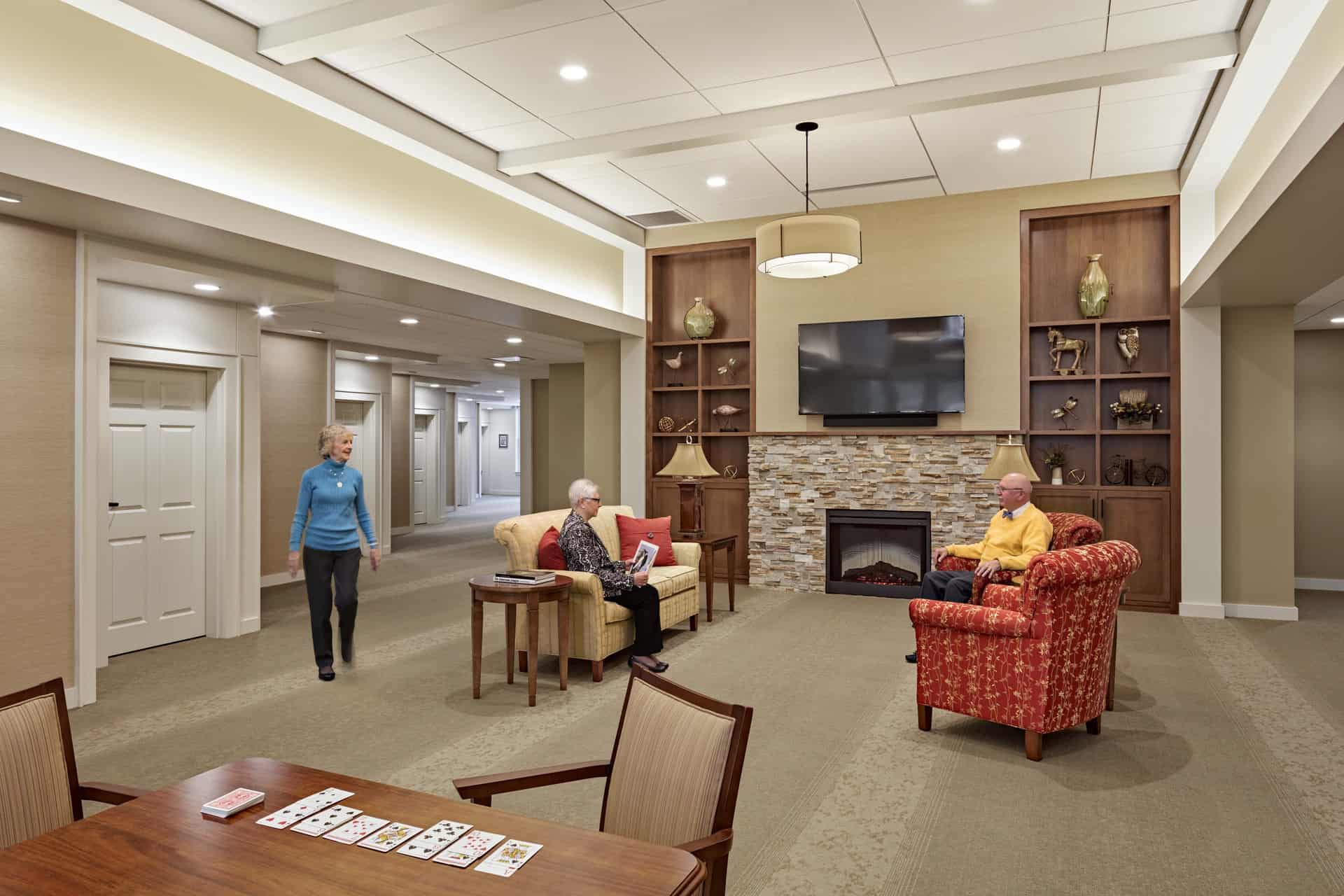
AmentaEmma_Duncaster_07

Duncaster Retirement Community

Baby Boomers are changing the way we provide housing and care,” says Michael O’Brien, president and CEO at Duncaster. “There is increasing desire for a robust program of health and wellness. As a result, design features are changing. We are breaking down the institutional feel to create an environment that is important to residents, their families and our caregivers.”

Memory care has additional design demands. “Conceptually, we approach design for memory care like we would any project. We start with the belief that design can make differences in people’s lives,” says Myles Brown, design principal with Amenta Emma Architects of Hartford.
“We are always focused on maximizing natural light and views to the outdoors, while creating well-proportioned, clearly organized, interconnected interior spaces that foster both social interaction and independence. The expertise comes in the form of subtle design details such as higher levels of artificial lighting, lighting control, interior finishes, accessibility/safety, and heightened visual clarity. Good design makes these details invisible to most users so
that no one would say, ‘This looks like a memory care project’.”
Duncaster added a 12-bed unit for memory care, doubling its capacity for this particular population. A majestic
100-year-old oak, known by residents as the Charter Oak, is the organizing element for the new building’s form and placement, symbolizing strength, endurance, protection, success and stability. It also became the inspiration for the
interior design’s “Connection to Nature” theme. Architects centered the building on the oak tree, stepping the footprint to bring southern light and glimpses of the tree to each resident room. They opened up the end of the building to a glassed activity room, or conservatory, where the tree can be viewed on all its magnificence.
At The Grove, a renovation rather than new construction, there was an opportunity to split two oversized rooms at the end of a hall to create a SAIDO room. SAIDO Learning is a new concept in memory care developed in Japan where residents are challenged with 30 minutes of math, reading and writing at least five times a week which has been
proven to reverse or slow the progress of dementia. The Grove is the first facility in New England to employ the method. Pamela Klapproth, Covenant’s executive director, says, “The program helps reduce signs and symptoms of agitated behavior.” [The program] helps bring them back to who they are as people, she notes.
The over-arching criterion, as a result of collaboration between the owners of each community and architects, was to design for cognitive clarity, simplicity, and way-finding ease to create a homelike environment that would promote health, wellness and safety for residents with dementia. While architects provided research on current best
practices from around the country, staff at each facility contributed expertise on the realities of caring for this special population and discussed how they wanted to care for them.
Adults with memory issues often suffer from sleep disorders. If they spend a great deal of time indoors, the ability to distinguish between day and night is blurred, upsetting circadian rhythms. In both facilities, the abundance of natural light is critical, as research shows it contributes to learning and productivity. The open concept also is critical.
“The most important thing is to have an environment where residents have lots of socialization,” says Parmelee. At Duncaster, everything revolves around a country kitchen. Residents can be involved in food preparation or setting tables. Breakfast is not served at a regimented time, allowing that some people are early risers and others are not. They can come to the kitchen area in a robe and pajamas, read the newspaper, just like they did at home.
Both facilities utilized interior strategies to help residents negotiate their surroundings. Colors and finishes were chosen with respect to degenerating vision in seniors. Contrasting colors between vertical and horizontal surfaces help resi
dents feel boundaries. Subtle changes in floor patterns add interest and define spaces without being too contrasting. Some seniors may perceive high contrast as a hole or cliff, which can be disorienting.
Health professionals think environments such as these will create better outcomes for residents suffering from dementia. This would include fewer hospital admissions and residents who are more socially engaged.“
We will be measuring these outcomes overtime,” O’Brien says. “I think we are providing better care to the whole person, not just medical but social as well,” says Parmelee. Informed design helps meet that expectation.
Nicole M. Owens is a marketing associate and Myles R. Brown, AIA, LEED AP, serves as a principal-in-charge of the Senior Living studio at Amenta Emma Architects in Hartford, Conn.


Preparing document for printing…

0%

e516 hot topics
    FacebookXLinkedInEmail

You may also like

Multi Residential

Nauset Delivers 59-Unit Passive...

January 22, 2025
Mixed-use • Multi Residential

Boston’s Planning Department...

January 17, 2025
Multi Residential

MassHousing Announces $8M in...

January 16, 2025
Multi Residential

 MassHousing Awards $447K for...

January 9, 2025
Trends and Hot Topics

Report Highlights Design-Build’s...

January 9, 2025
Contributor

Ask the Electrician: What are the...

January 8, 2025
Multi Residential • Restoration/Renovation

Ribbon Cut for $4.5M Transitional...

January 6, 2025
Contributor

What’s Next for Construction in...

December 30, 2024
  • Gray.png
  • Pedigree.png
  • PWC.png
  • INterstate.png

HIGH-PROFILE MONTHLY
615 School St.
Pembroke, MA  02359
Phone: 781 294 4530
Fax:  781 293 5821
info@high-profile.com

Quick Links

  • About Us
  • Contact Us
  • Subscribe
  • Advertise
  • My Account

Stay Informed

Sign up for Fast Facts Friday, our weekly e-newsletter, and stay up-to-date with the latest industry news!

Sign up
Subscribe to High-Profile Monthly to receive an email notice of each new article!
Loading

Copyright © 2026 High-Profile Monthly.

  • Twitter
  • Facebook
  • Instagram
  • Linkedin
  • YouTube
  • RSS
  • Sign In
  • My Account