by Kristian C. Kowal
As colleges and universities adapt to new paradigms in science, technology, engineering, and mathematics (STEM), higher ed learning environments need to adapt with them. The question is, how do we reach a generation of learners in a media-saturated society who have never known a world without the interface of technology and handheld devices?
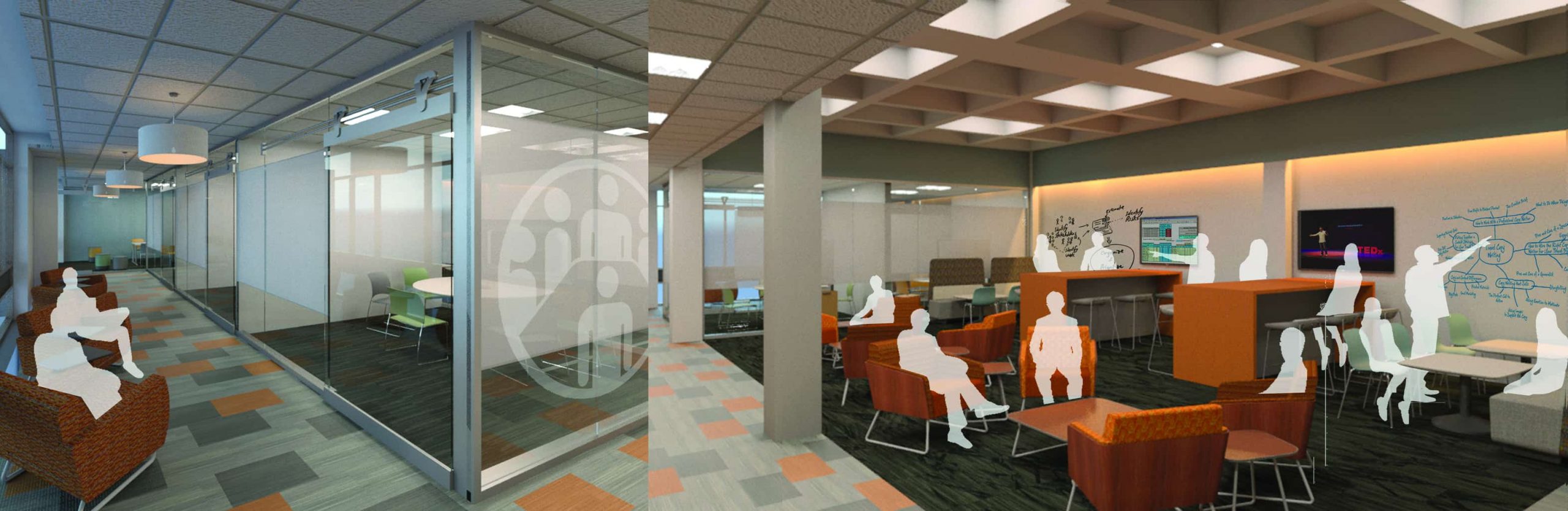
Concept design of a university innovation center, with options for collaboration or quiet study / rendering by WBRC Architects Engineers
Just as pedagogies are changing from the “sage on the stage” (i.e. lecturing professor) to a “guide on the side” (i.e. facilitating professor) A/E professionals must become engaged partners with their higher education clients in order to provide solutions that address new learning styles and teaching methods while embodying each institution’s unique vision.
Several national trends are influencing today’s STEM buildings:
- Technology must be fluidly integrated into classrooms, teaching labs, and collaboration spaces.
- Spaces need to accommodate new teaching methodologies, such as the flipped classroom (where video lectures are viewed at home and “homework” is completed in the classroom in the form of exercises, projects, and discussion).
- Renewed emphasis on the value of project-based small group work.
- An interdisciplinary, experience-based approach to developing workforce-based skills and critical thinking.
New technologies and approaches are pushing educational facilities design in new directions, but discipline is critical. Rather than going from a single-purpose classroom (i.e., lecture) to a nonstructured classroom, consider designing classrooms that have two or three variations in furniture arrangements. Give students a choice of space types, such as private study “phone booths” when work needs to happen in an uninterrupted environment.
In student-focused buildings, provide a greater ratio of collaboration spaces to scheduled classrooms and teaching labs. This is a major shift from the past. It’s important to think critically about these spaces. Lounge areas are still an important type of space within higher-education facilities, but we need to be careful about creating spaces that are too unstructured. Instead, include areas specifically designed for small group- and project-based peer interaction. Design them to be acoustically isolated and enhanced with technology and furniture that will allow students to rearrange the room to best fit the task at hand.
As the boundaries between the life sciences and physical sciences continue to blur, the need for flexible teaching labs that accommodate multidisciplinary experiments and demonstrations will increase, and designers can make the transition between these labs and adjoining spaces fluid and intuitive.
The beauty of what’s happening in STEM lab environments is that, rather than creating some radical new paradigm, we are responding with simple, logical decisions such as configuring utilities, gases, and other core functions along the perimeter of a lab and leaving the center of the lab open to facilitate a flexible arrangement of tables, chairs, and lab stools. Designing all labs and classrooms on the same repetitive structural module enables any space to function as a teaching lab, a research lab, or a classroom.
Ultimately these changes in pedagogy and the built environment need to involve students in hands-on discovery at an early stage in their educational experience and enable them to function effectively in collaborative and multidisciplinary environments. These changes will help prepare today’s and tomorrow’s students to successfully enter the workforce and intelligently design the future of our complex world.
 Kristian Kowal, AIA, NCARB, CDT, is a principal at WBRC Architects Engineers.