by Ross Vliestra and Ed St. Peter
In the ever-evolving landscape of scientific research, marked by rapid technological advancements, shifting research priorities, and the rise of remote and collaborative work, adaptability has become a critical factor in laboratory design. Traditional fixed layouts, though once the norm, now present significant limitations that can hinder a researcher’s ability to adapt to evolving circumstances and embrace emerging technologies, ultimately leading to long-term financial burdens and growing inefficiencies.
Conventional lab setups typically feature rigid layouts that house workstations and equipment, with limited options for accommodating new equipment or rearranging the workspace. Utilities such as gas lines, data connections, power outlets, and plumbing are typically hardwired into the lab’s infrastructure, making changes or additions cumbersome and expensive. This inflexibility can lead to suboptimal conditions for researchers, hampering productivity and innovation.
The Solution: Modular and Adaptable Workstations
To address the shortcomings of traditional lab setups and keep pace with the dynamic research landscape, modular and adaptable workstations have emerged as a game-changing solution. These innovative designs offer a multitude of benefits:
- Flexibility and Adaptability: Researchers can quickly reconfigure their workspaces to accommodate new equipment, research projects, or changing needs without the burden of major construction work.
- Space Optimization: Modular workstations enable efficient use of available space and can be customized to fit seamlessly into various building layouts, maximizing spatial utilization.
- Time Savings: Accelerated installation processes allow research teams to get up and running faster, minimizing downtime and maximizing productivity.
- Collaboration and Resource-Sharing: Modular designs facilitate easy sharing of equipment and infrastructure, encouraging collaboration among researchers and fostering a synergistic environment.
- Cost-Efficiency: Compared to traditional fixed designs, modular workstations result in lower construction and renovation costs, providing a greater return on investment. Cost savings results come from ease of reconfiguration internally, providing quicker payback.
- Safety and Compliance: Meeting the latest safety and regulatory requirements, modular workstations ensure that researchers operate in a well-protected environment while remaining compliant with industry standards.
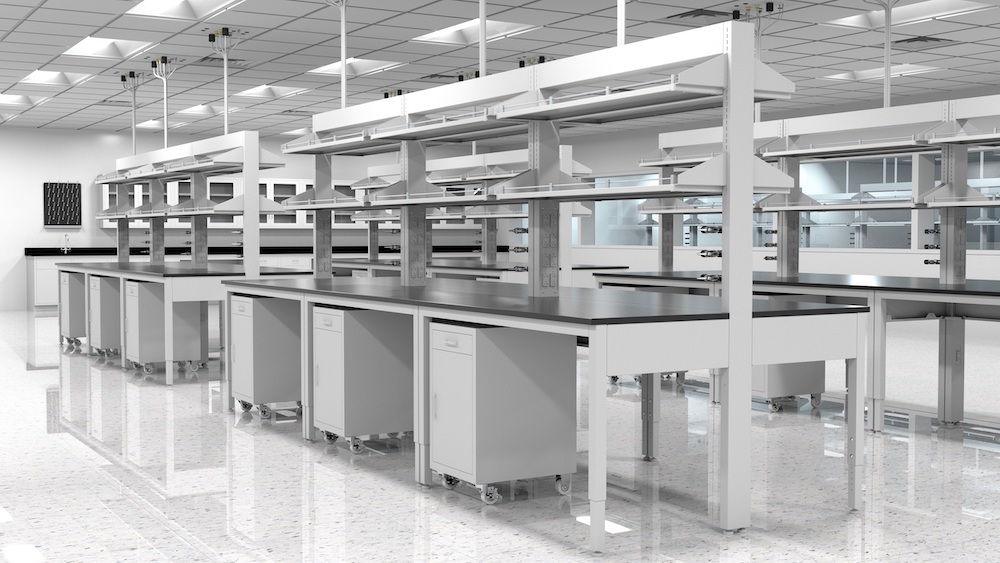
- Futureproofing: With the ability to easily upgrade or reconfigure, modular workstations can accommodate new technologies and research requirements, ensuring long-term viability and adaptability. When modular lab furniture is used, facility teams can move cabinets and even change the entire floorplan to improve traffic flow, incorporate new technologies, and increase accessibility, and much easier than with fixed casework. As storage needs change, modular furniture also allows for an easy increase in storage density by adding more shelves and cabinets to the existing installation.
The Future of Lab Design: Modular and Adaptable Solutions
When selecting modular and adaptable furniture for your laboratory, it is essential to consider features such as height-adjustable countertops and shelving; pre-installed power, data, and gas services; and load capacity and sturdiness. STEM Solutions LLC offers the Hanson Lab Solutions product lines which feature two distinct adaptable lines to meet varying needs: the budget-friendly M series, and the heavy-duty Agility series. The Agility series has a load capacity of over 3000 pounds, making it one of the most durable modular systems available and particularly well-suited for industrial applications.
By embracing the modular approach to laboratory design, researchers can position themselves at the forefront of scientific discovery, equipped with the flexibility and adaptability necessary to grow alongside their research endeavors.
Ross Vlietstra is the national new business development manager for Hanson Lab Solutions, and Ed St. Peter is the managing member of STEM Solutions LLC.