• Twitter
  • Facebook
  • Instagram
  • Linkedin
  • YouTube
  • RSS
  • Sign In
  • My Account
High-Profile MonthlyThe Source for AEC Industry News
  • All News
      • Up Front
      • Groundbreaking
      • Topping Off
      • Ribbon Cutting
      • View All Up Front Stories
      • StMarysBank_NorthBranch_ToppingOffNorth Branch Construction Celebrates Topping Off for new St. Mary’s Bank Branch
      • Special Features
      • Contributor
      • Green
      • J.E.D.I.
      • Mechanical / Electrical / Plumbing (MEP)
      • Vision
      • Women In Construction
      • Regions
      • Connecticut
      • Northern New England
      • Popular Sectors
      • Cannabis
      • Corporate
      • Education
      • Healthcare
      • Interiors
      • Landscape/Civil
      • Life Science
      • Multi Residential
      • Restoration/Renovation
      • Retail/Hospitality
      • Senior/Assisted Living
      • Technology & Innovation
      • Other News
      • Awards
      • Community
      • COVID-19
      • Mixed-use
      • Municipal
      • National/International
      • Organizations and Events
      • People
      • Philanthropy
      • Products and Services
      • Real Estate
      • Training and Recruitment
  • Subscribe
  • Next Issue
  • Archive
  • Advertise
  • Podcast
  • A/E/C Associations
  • Calendar
High-Profile Monthly
  • All News
      • Up Front
      • Groundbreaking
      • Topping Off
      • Ribbon Cutting
      • View All Up Front Stories
      • StMarysBank_NorthBranch_ToppingOffNorth Branch Construction Celebrates Topping Off for new St. Mary’s Bank Branch
      • Special Features
      • Contributor
      • Green
      • J.E.D.I.
      • Mechanical / Electrical / Plumbing (MEP)
      • Vision
      • Women In Construction
      • Regions
      • Connecticut
      • Northern New England
      • Popular Sectors
      • Cannabis
      • Corporate
      • Education
      • Healthcare
      • Interiors
      • Landscape/Civil
      • Life Science
      • Multi Residential
      • Restoration/Renovation
      • Retail/Hospitality
      • Senior/Assisted Living
      • Technology & Innovation
      • Other News
      • Awards
      • Community
      • COVID-19
      • Mixed-use
      • Municipal
      • National/International
      • Organizations and Events
      • People
      • Philanthropy
      • Products and Services
      • Real Estate
      • Training and Recruitment
  • Subscribe
  • Next Issue
  • Archive
  • Advertise
  • Podcast
  • A/E/C Associations
  • Calendar
Contributor • Education

Design for Neurodiversity

February 22, 2024
The Young Classroom at Smith College was designed to mitigate common distractions and to offer choice and variety, yet with predictable furniture placement that indicates purpose – a concept designers call fixed variation.

by Michael Tyre

Creating inclusive higher education spaces that support a variety of personalities, needs, and abilities has become an increasing focus of architectural design. Historically, architects – through efforts like ADA and universal design – have focused on addressing physical ability in the design of the built environment. As our conception and awareness of diversity and inclusivity grows, we must consider broader concepts in the effort to create spaces of belonging. One of those emerging concepts is neurodiversity.

Neurodiversity recognizes that people experience and interact with the world around them in different ways. The idea is there is no “correct way” for the brain to work. Instead, there is a broad range of ways people perceive and respond to the world, and these differences are to be embraced and encouraged.

As architects striving to create inclusive spaces in which everyone can thrive, we must consider the implications of a neurodiverse population. Mitigating sensory distractions such as visual contrast, reflectivity, noise, and large crowds are critical approaches for addressing neurodivergence in the built environment. Other design strategies include low-stimulation, quiet environments for focus; avoidance of highly reflective and bright finishes; measures to control glare and mechanical noise; layout and furniture to indicate purpose; distinct, identifiable community areas; avoidance of intense patterns; “zone-finding” by way of material applications; and occupant control of lighting levels.
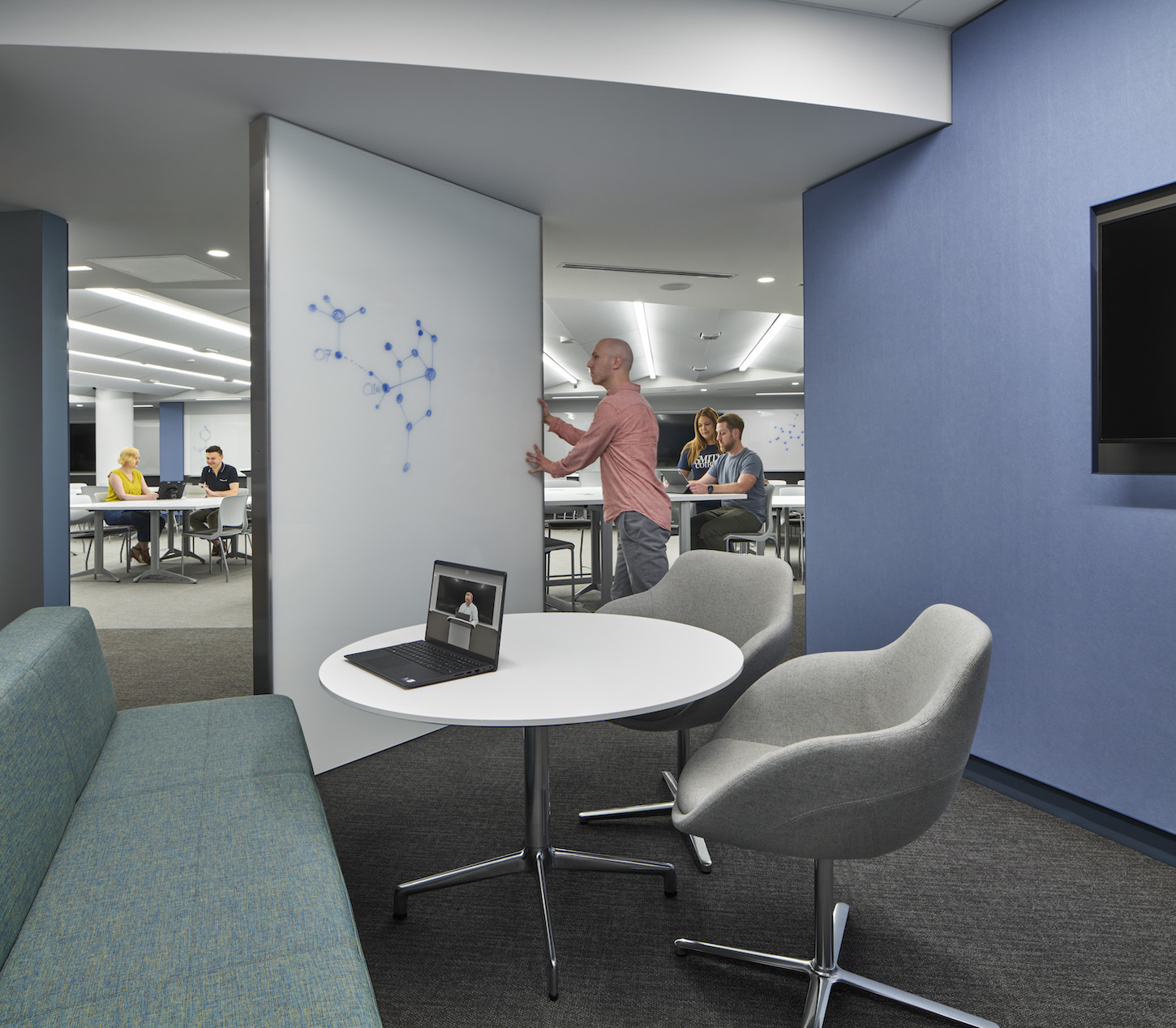
Smaller learning rooms of various sizes and furnishings are intended to be used simultaneously with the large collaborative space, supported by AV technology to allow for display of content and user participation.

In addition to controlling sensory distractions, just as critical is providing users with the agency of choice. Like other design strategies supporting inclusion, environments that offer occupants a choice in the setting in which they feel most comfortable is paramount. “One size fits all” is no longer a productive model, as we have seen in the recent evolution of classroom and workplace design. For neurodiverse students and staff, this does not mean creating a sea of mobile, flexible furniture configurations that can be endlessly rearranged, but controlling environmental factors to mitigate distraction and anxiety. We promote the concept of “fixed variation” — offering personal choice and predictability through distinct spaces and finish/furniture arrangements.

Environments of fixed variation will offer a range of spatial qualities and furnishings that support the central program (classroom, office, meeting space, etc.). Often, these spaces will feature types of alternate areas at a smaller scale to support individuals and small groups that prefer to learn or work in a less open, distracting environment. By leveraging technology, these alternate spaces can operate simultaneously as the main space.

Design to support neurodiversity builds upon this spatial variety with sensitivity to addressing common sensory distractions. Controlling background noise and improving speech clarity with mechanical and finish solutions is important. A palette of interior materials that is subtle can help identify zones within the space to aid in wayfinding. Additionally, providing a level of user control of elements, such as lighting levels and enclosure, helps spaces respond to personal preference.

Good design has the power to create better outcomes – this is why design matters. By focusing on the impacts environmental factors have on people, we can create inclusive spaces that people want to experience and help us all thrive in our pursuits. Institutions of learning need to ensure their most valuable assets are in spaces where ALL can flourish.

Michael Tyre

Michael Tyre, AIA is principal at Amenta Emma Architects.
highereducationdesign HPNews
    FacebookXLinkedInEmail

You may also like

Education

Rowse Architects Completes Boyle...

January 21, 2025
Contributor

Ask the Electrician: What are the...

January 8, 2025
Contributor

What’s Next for Construction in...

December 30, 2024
Contributor

Strengthening the AEC Community: A...

December 27, 2024
Contributor

Boston’s Commercial Real...

December 26, 2024
Contributor

Choosing a B2B PR Agency: Why it...

December 19, 2024
Contributor

A/Z’s 2025 Strategic Growth...

December 18, 2024
Education

Erland Construction Completes Two...

December 17, 2024
  • Gray.png
  • Pedigree.png
  • PWC.png
  • INterstate.png

HIGH-PROFILE MONTHLY
615 School St.
Pembroke, MA  02359
Phone: 781 294 4530
Fax:  781 293 5821
info@high-profile.com

Quick Links

  • About Us
  • Contact Us
  • Subscribe
  • Advertise
  • My Account

Stay Informed

Sign up for Fast Facts Friday, our weekly e-newsletter, and stay up-to-date with the latest industry news!

Sign up
Subscribe to High-Profile Monthly to receive an email notice of each new article!
Loading

Copyright © 2026 High-Profile Monthly.

  • Twitter
  • Facebook
  • Instagram
  • Linkedin
  • YouTube
  • RSS
  • Sign In
  • My Account