• Twitter
  • Facebook
  • Instagram
  • Linkedin
  • YouTube
  • RSS
  • Sign In
  • My Account
High-Profile MonthlyThe Source for AEC Industry News
  • All News
      • Up Front
      • Groundbreaking
      • Topping Off
      • Ribbon Cutting
      • View All Up Front Stories
      • StMarysBank_NorthBranch_ToppingOffNorth Branch Construction Celebrates Topping Off for new St. Mary’s Bank Branch
      • Special Features
      • Contributor
      • Green
      • J.E.D.I.
      • Mechanical / Electrical / Plumbing (MEP)
      • Vision
      • Women In Construction
      • Regions
      • Connecticut
      • Northern New England
      • Popular Sectors
      • Cannabis
      • Corporate
      • Education
      • Healthcare
      • Interiors
      • Landscape/Civil
      • Life Science
      • Multi Residential
      • Restoration/Renovation
      • Retail/Hospitality
      • Senior/Assisted Living
      • Technology & Innovation
      • Other News
      • Awards
      • Community
      • COVID-19
      • Mixed-use
      • Municipal
      • National/International
      • Organizations and Events
      • People
      • Philanthropy
      • Products and Services
      • Real Estate
      • Training and Recruitment
  • Subscribe
  • Next Issue
  • Archive
  • Advertise
  • Podcast
  • A/E/C Associations
  • Calendar
High-Profile Monthly
  • All News
      • Up Front
      • Groundbreaking
      • Topping Off
      • Ribbon Cutting
      • View All Up Front Stories
      • StMarysBank_NorthBranch_ToppingOffNorth Branch Construction Celebrates Topping Off for new St. Mary’s Bank Branch
      • Special Features
      • Contributor
      • Green
      • J.E.D.I.
      • Mechanical / Electrical / Plumbing (MEP)
      • Vision
      • Women In Construction
      • Regions
      • Connecticut
      • Northern New England
      • Popular Sectors
      • Cannabis
      • Corporate
      • Education
      • Healthcare
      • Interiors
      • Landscape/Civil
      • Life Science
      • Multi Residential
      • Restoration/Renovation
      • Retail/Hospitality
      • Senior/Assisted Living
      • Technology & Innovation
      • Other News
      • Awards
      • Community
      • COVID-19
      • Mixed-use
      • Municipal
      • National/International
      • Organizations and Events
      • People
      • Philanthropy
      • Products and Services
      • Real Estate
      • Training and Recruitment
  • Subscribe
  • Next Issue
  • Archive
  • Advertise
  • Podcast
  • A/E/C Associations
  • Calendar
Contributor • Life Science • Trends and Hot Topics

Achieving Sustainability in Life Sciences Projects

June 23, 2017

by Katrina Miaoulis

With the convergence of research vectors, life sciences buildings often host numerous plants, animals, and unique habitats. Because of the varying requirements that each of these species have, it is vital that the design and execution of sustainability measures be tailored to the building’s intended use. To maintain the required environment and safety provisions, these spaces often require a significant amount of outside (air change rates) relative to a non-science building (i.e., office). While many other types of commercial buildings can set project goals and certification levels by the program type, a life sciences building must consider exactly what the labs will be used for, who will be using them, and who or what will be inhabiting them.

Yale School of Medicine: Vanderweil designed this building to include micro-isolators, animal watering systems, standby power, and programmable lighting. / © Payette

While these questions pose an exciting challenge for project teams, many of the operational considerations must be analyzed in predesign for a project’s success. For example, the thermal comfort requirements in a lab are contingent upon the species and testing done there. It may be a lab that requires humidity and temperatures emulating the tropics or ones similar to Antarctica. Systems need to be selected according to the lab types, and the orientation of these systems in the building must be considered.

Air filtration and ventilation can also be a more strenuous design in life sciences buildings. Particulates in the air could affect lab tests and habitats, requiring more-advanced air filters to be used. A recent trend of increased spectrometry research has raised awareness on background gaseous levels from outdoors as well as within the lab and their potential impact on test stability. In addition to clean air, the products used in the space must be controlled. Certain cleaning products and pesticides will have to be regulated and nonhazardous. Materials within the labs will also have to be monitored for dangerous content such as VOCs and urea-formaldehyde, which could affect the lab environment.
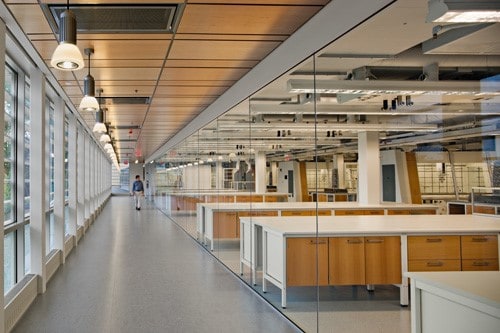
AstraZeneca: Vanderweil designed a cancer research center and vivarium expansion that included chemical and biological research labs. / © Wilson Architects

In addition to these project issues, life sciences buildings will operate for more than the traditional 40-hour work week. Lab systems operate continuously (even during unoccupied periods) to research and testing operations as well as to maintain the required safety/environmental conditions. This will increase the energy use in the space dramatically. Because of this, it is crucial to optimize the design criteria, mechanical systems, building orientation, any passive ventilation strategies, and energy-efficient lab equipment. In addition to these strategies, renewable energy generation may be considered to offset some of the lab’s usage. Whether this is in the form of a geothermal, solar thermal, or PV system, heat and electricity can be harnessed from the environment to bring into the space and reduce the building’s environmental impact.

Overall, while life sciences buildings pose a unique set of challenges that most commercial spaces do not experience, with thoughtful planning completed early on in the project, the building can be designed sustainably. Considerations such as lab usage, requirements, and operations are fundamental in the building layout, system selection, and energy reduction strategies that can then be incorporated into the design. If a commitment to sustainable design and energy efficiency is established early, it can be attained.

Katrina Miaoulis, LEED AP BD+C, ID+C, WELL AP, is green building and sustainability project manager at Vanderweil Engineers.

@RGVanderweil

life science. by line p717 sustainability vanderweil
    FacebookXLinkedInEmail

You may also like

Life Science

Werfen’s 169,000sf Advanced...

January 15, 2025
Trends and Hot Topics

Report Highlights Design-Build’s...

January 9, 2025
Contributor

Ask the Electrician: What are the...

January 8, 2025
Contributor

What’s Next for Construction in...

December 30, 2024
Contributor

Strengthening the AEC Community: A...

December 27, 2024
Contributor

Boston’s Commercial Real...

December 26, 2024
Contributor

Choosing a B2B PR Agency: Why it...

December 19, 2024
Contributor

A/Z’s 2025 Strategic Growth...

December 18, 2024
  • Gray.png
  • Pedigree.png
  • PWC.png
  • INterstate.png

HIGH-PROFILE MONTHLY
615 School St.
Pembroke, MA  02359
Phone: 781 294 4530
Fax:  781 293 5821
info@high-profile.com

Quick Links

  • About Us
  • Contact Us
  • Subscribe
  • Advertise
  • My Account

Stay Informed

Sign up for Fast Facts Friday, our weekly e-newsletter, and stay up-to-date with the latest industry news!

Sign up
Subscribe to High-Profile Monthly to receive an email notice of each new article!
Loading

Copyright © 2026 High-Profile Monthly.

  • Twitter
  • Facebook
  • Instagram
  • Linkedin
  • YouTube
  • RSS
  • Sign In
  • My Account