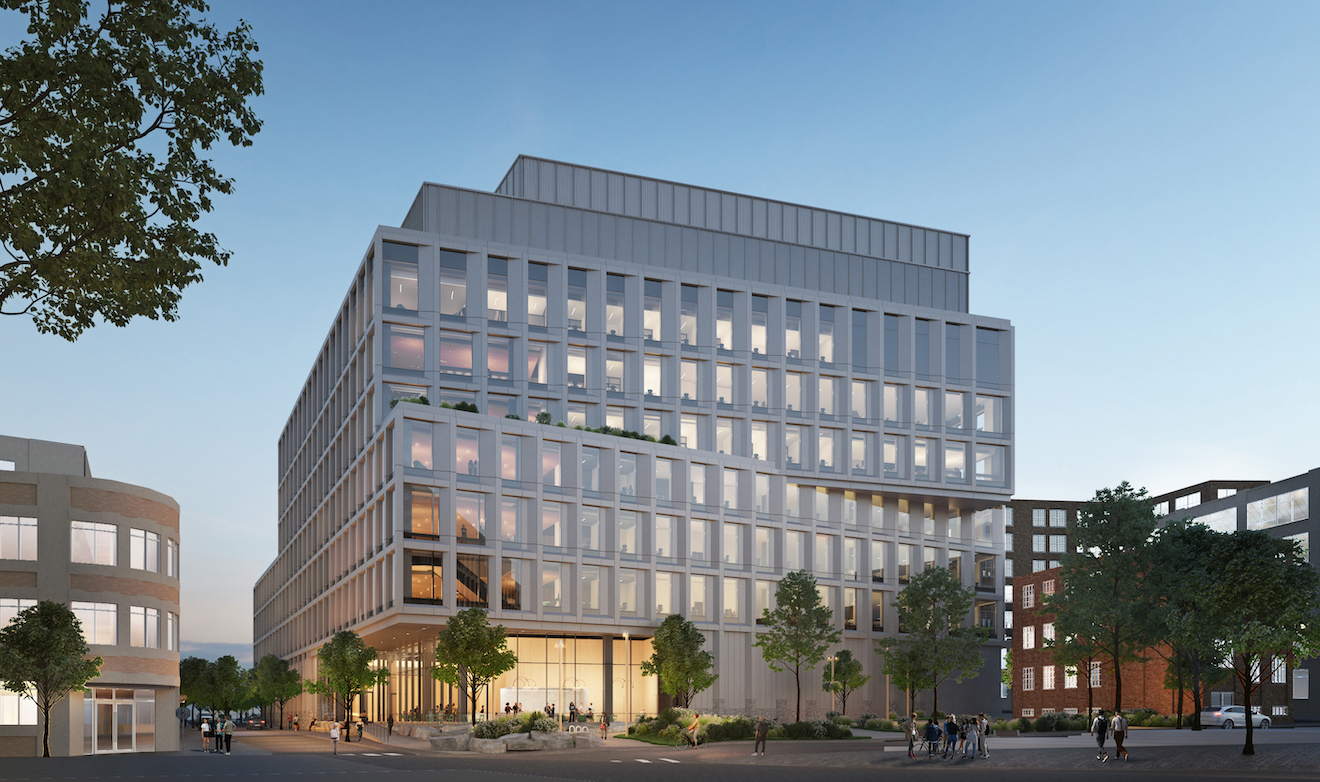
High-Profile’s Anastasia Barnes recently caught up with Paul E. Dietel, assistant vice president for planning design and construction at Brown University. Dietel expands on the university’s Danoff Laboratories project, which is currently in the early stages of construction with an anticipated opening date of spring 2027. Building foundations and substructure construction will be underway for the next several months.
Anastasia Barnes: I know this building is set to be one of the first net-zero laboratory constructions in New England. What specific challenges have you encountered in designing and constructing a net-zero lab facility, and how do you envision this approach influencing future projects at Brown and across the region?

Paul E. Dietel
Paul E. Dietel: Brown University has a net zero by 2040 goal, with 75% net zero by 2025 that has already been achieved. As a result of Brown’s sustainability goals, full electrification for the Danoff Laboratories project was identified early in the feasibility stage of the project. The team was able to work in a unified way from the beginning using a process called “Choosing by Advantage,” or CBA. Available options for each of the systems were weighed and evaluated for the best possible outcome, finding the right balance of attributes like energy intensity, embodied carbon, CO2 emissions, resiliency, programmatic needs and benefit to research.
Laboratory buildings are very challenging for energy usage given the required air flow rates to make the building safe for occupants. The lab areas of the building are designed for up to six air changes per hour, however some areas could be as high as 14. These airflow rates are equivalent to trying to condition the building with the windows open, which is particularly challenging. The Danoff Laboratories building will capture as much energy as possible before air is exhausted from the building and transfer this energy to the supply air coming into the building. This building will implement new chiller technology that is efficiently capable of producing large quantities of very cold water (5°F) that will be used to reduce the exhaust air temperature from approximately 74°F to 8°F. All the chillers in the building will utilize non-ozone depleting refrigerants that have a global warming potential that is 94-97% less than what was commonly installed in buildings in 2020. Heating, ventilation, and air conditioning systems typically use hot and chilled water to provide heating and cooling within the building. One challenge is the system cannot use water that is generally used to provide heating and cooling in this building. A portion of the water must be mixed with a special glycol that prevents the water from freezing and allows the fluid to remain viscous to allow the heat transfer fluid to flow easily within the piping.
Energy recovery is typically accomplished in a normal office building by using an energy wheel that rotates between the supply and exhaust air streams. With those systems, there is some mixing between the exhaust and supply air streams. In laboratory buildings, the potentially hazardous exhaust air streams are not permitted to mix. As the first stage of heat recovery, water treated with glycol will flow through coils like the radiator in your car to extract the energy in the exhaust air and transfer the energy to the supply air. During the summer, the cool air from the building will be used to precool the supply air and during the winter this system will preheat the cold outdoor air. This energy recovery system can circulate up to 1,600 gallons per minute. Then as a second stage of energy recovery during the winter, the exhaust air temperature will be further chilled to 8°F as much heat as possible before the exhaust air exits the building. Without treating the water, it would be like trying to slurp a Del’s frozen lemonade through a straw. To extract as much energy as possible, this system can flow up to 740 gpm in 14 inch diameter pipes. This exhaust source energy recovery is currently the largest system of its kind planned in the United States.
AB: The building includes emergency backup systems for resiliency. How is the integration of these systems planned to ensure both sustainability and reliability, especially considering the complex energy demands of laboratory environments?
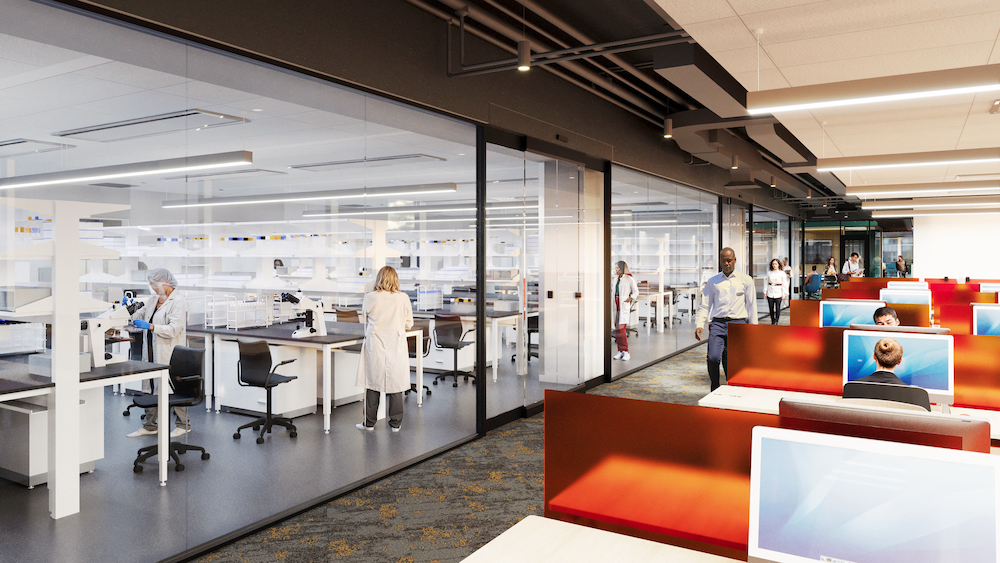
Interior lab / Rendering courtesy of Ballinger
PD: Being in Rhode Island and so close to sea level, the impact of climate change and sea level rise has been considered in the design and construction of this building from its inception. The team has worked diligently to ensure that redundancy is provided in the building’s mechanical, electrical and plumbing systems so that research is preserved through a weather event. Standby power is provided by diesel generators, sized for the building’s critical loads. To reduce the standby capacity, we provided gas fired boilers in lieu of doubling the generator capacity to support the electrified HVAC systems. The building will be provided with three separate connections to the power grid. In the event of an electrical feeder failure, the building can be quickly transferred to another circuit to minimize the time that the building operates on generator.
AB: What do you see as the broader impact of this facility on the life sciences ecosystem in Providence and the state of Rhode Island, and how will it contribute to regional innovation and growth?
PD: Brown University is solidifying its place as a premiere multi-disciplinary research institution in the country with this state-of-the-art building. By providing a collaborative place that is human focused and designed for the next 75 years of research, Danoff Laboratories looks to be a hub for life sciences research. Our location in the Knowledge District in Providence positions us as part of a revitalization of the former Jewelry District near other research facilities within two blocks of this project, including Brown’s 225 Dyer Street and 70 Ship Street, and the Rhode Island State Health Labs, which is currently under construction.