
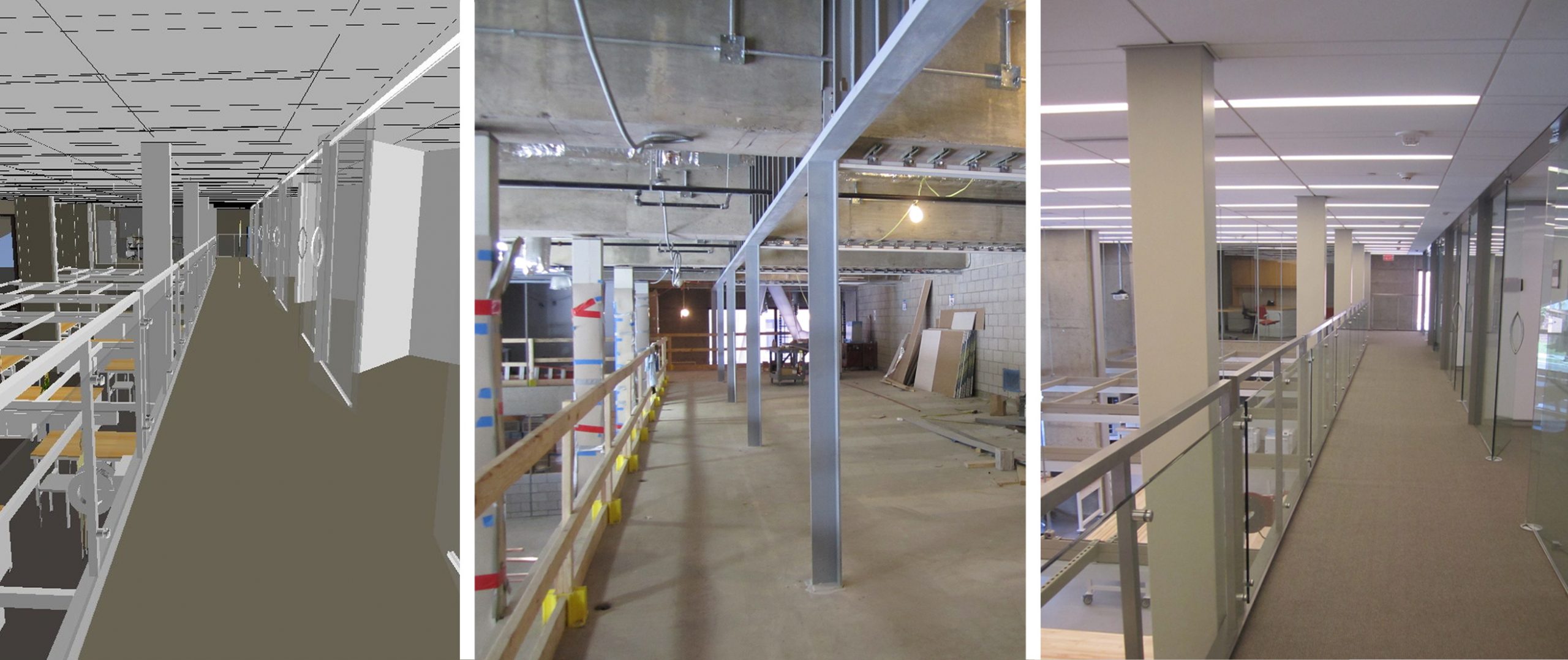
 BIM is about unlocking the power of information. Building Information Modeling (or BIM), is becoming more widely recognized in the construction industry. This technology provides a digital, 3D representation of the building process used to facilitate exchange of information in digital format for the entire project team.
BIM facilitates a cultural shift toward collaboration. This technology is cutting edge in the industry; however the most important thing to consider about BIM is that there must be an internal culture that supports collaboration and the practical use of these tools. BIM facilitates a much higher level of coordination among the clients, and design and construction team. However, there must be a cultural shift from the traditional design-bidbuild methodology which typically leads to adversarial relationships between the architect and the contractor, to a spirit of total team collaboration which is inherent in the process. The value of the relationships among team members should not be underestimated.
BIM provides both tangible and intangible cost savings. Adding the power of virtual design coordination provides tangible examples of enhanced constructability and value management, as well as the efficiency for prefabricated assemblies. Time and space clashes between various disciplines are much more readily identified in 3D- identifying and fixing these issues ahead of time has been one of the most utilized aspects of BIM technology easily saves a project thousands of dollars and weeks of wasted time waiting for components to be fabricated. 3D visualization supports the design and construction industry with these aforementioned ‘direct’ (or tangible) savings and ‘indirect’ (or intangible) savings resulting from minimized design and onsite construction time and associated administrative and general conditions costs.
BIM is much more than creating a 3D model. Adding 4D (time) and 5D (cost) provides the ability to demonstrate how redesign impacts the program and budget. This technology is becoming more prevalent because it maximizes BIM’s potential in the design and construction process, particularly in the pre-construction phase of a project. 4D helps to answer the question: What impact will this change have on the schedule? More importantly, what will the impact be on the end users and project stakeholders? 5D integrates the estimate model with Timberline Estimating and MS Excel and provides a visual quantity take off. 5D identifies design changes and updates quantities in real time. Put another way, 5D is a visual estimator with a Timberline database. 5D also assists with developing cash flow analyses and calculating project staffing requirements.
With BIM there is still somewhat of a fear of the unknown. Many professionals within the industry have not embraced the full potential of the technology and are only using 3D to provide an enhanced project rendering. The barriers of data ownership and intellectual property still remain. However, the careful selection of partners will ensure that it works because all have a similar collaborative philosophy –that they will reap long-term benefits by creating sustainable relationships with each other and their clients. Based on where the construction industry is headed, there will eventually be a transformational change as the trend toward integration across the entire life span of a project becomes greater: from concept to construction, to operation and ultimately decommissioning.
Future of the BIM workforce. The BIM Empowered A/E/C Profession will invariably be composed of individuals with ranges of technical skills and professional experiences from different generations. This multi-generational, ad hoc team depicts how the Gen Xer is a likely fit for this revolution, how the Baby Boomer has to adapt to survive, and how the Millennials are poised to transform BIM from a novel process to an industry norm. Designers and builders at all levels of the profession have been impacted by the emergence of BIM. This shift, with a heavy reliance on technology and input from builders during the design process, will empower a new generation of A/E/C professionals and advance them into leadership positions very early in their careers.
Marcia Kellogg is the Marketing Manager at Standard Builders in Newington, Connecticut.