
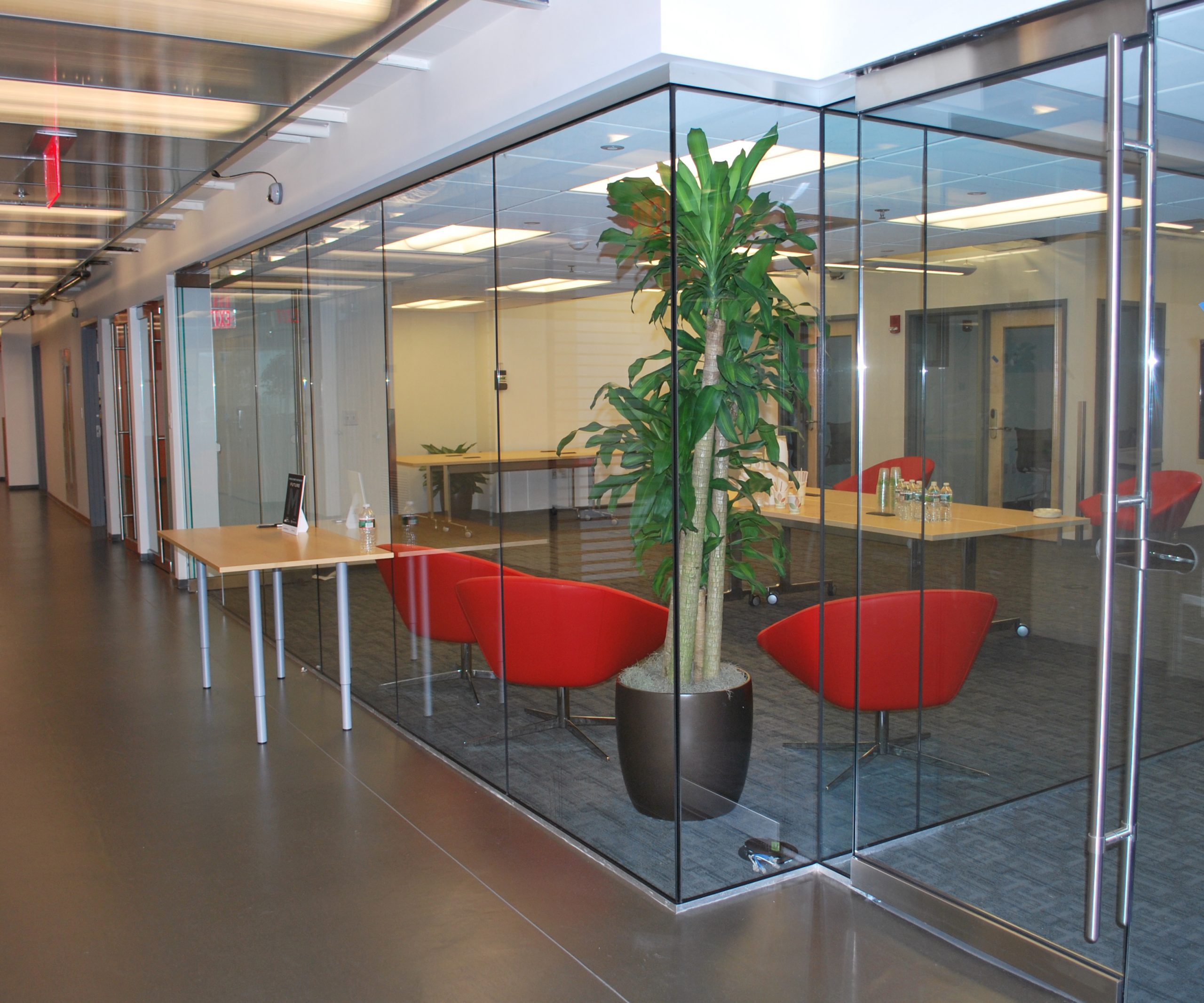
 Boston – It used to be a trend for start-ups with limited funds and few employees. Now it’s made its way into the main stream. The trend? Decreasing individual office space and adding more break-out areas to promote collaboration and informal meetings among employees.
Back in 2010, Commodore Builders was hired to build out 70,000 SF on two floors of the Cambridge Innovation Center (CIC), at One Broadway. The state-of-the-art facility became a flexible office building designed to house young technology and life sciences companies. The environment is designed with glass, natural light, and high tech finishes to create an exciting, high energy atmosphere for the innovators who occupy the space. On the 4th floor, a former parking garage ramp was converted into office space. Thirty-two sky lights and two light tubes carry natural daylight from the 5th floor roof, down through the 4th floor to the 3rd floor offices.
The layout at CIC is extraordinarily dense. This density is a catalyst for creating new methods of way-finding, which include the use of vibrant colors, landmarks, and paths that wind through the neighborhoods of office pods. During the design phase, particular attention was paid to connectivity and communications. Dry erase whiteboard paint is used throughout to influence the spontaneous exchange of ideas and conference rooms are placed strategically for meetings requiring more privacy.
CIC offices are designed to be flexible, without feeling temporary. Ghost doors, the equivalent of door frames with frosted glass, are installed to quickly accommodate a new configuration for an existing or new tenant. A window can be transformed into a door in just minutes, a huge asset for quickly expanding companies and departments. Phantom doors, or preframed doorways, are designed within the drywall. If a tenant’s business grows, a door can quickly be cut out of the drywall to provide a link to bigger space. Neighborhoods of office pods can expand and contract in minutes.
This highly collaborative, flexible concept took off and in 2013 Commodore Builders partnered with CIC once again. Now at 101 Main Street, an adjacent building to One Broadway, Commodore is building out another two floors of space for CIC. This time, the existing offices running around the perimeter are being renovated and converted into private meeting pods and the open areas in the middle are being used as additional open office space. Bob McAuliff, Commodore’s Vice President and the Project Executive for this project, states, “I oversee a large percentage of Commodore’s tenant interior projects, and I’ve noticed a definite increase in our corporate clients’ preference for open office designs and a push from the building owners to accommodate their requests.” The projected is scheduled for completion in October 2013.
In the past few years, the concept of smaller individual offices and more open spaces has been rising in popularity. Companies, both big and small, are utilizing the model to create a culture of collaboration and a cost effective use of real estate. Open office designs have become the norm as companies strive to eliminate physical barriers to communication and create a more inviting place for employees to connect.
Over the last year, Commodore has worked with a wide range of clients, including Nitsch Engineering, Brightcove, allen & gerritson, and T3 Advisors, on projects each containing an increased emphasis on more open, collaborative spaces. Nitsch Engineering, a Boston based civil engineering and land surveying firm, moved into their new, LEED Gold certified, location at 2 Center Plaza after growing out of their previous office. Lisa A. Brothers, PE, LEED AP BD+C, President and CEO of Nitsch, stated “In our new location, we wanted a space that encouraged interaction and collaboration – not only among our employees but clients and guests visiting our office as well. The light open areas and break out spaces with seating and tables accommodate the spontaneous exchange we were hoping for.”