
Boston – In late October, PwC and the Urban Land Institute (ULI) Americas released their annual report, Emerging Trends in Real Estate 2025. The report outlines new market dynamics, markets to watch, and the property sector opportunities influencing the industry’s overall health. On Nov. 12, PwC and ULI Boston/New England assembled a panel of locally-based CRE professionals to share their thoughts on how those trends are impacting capital markets with a gathering of nearly 200 CRE professionals. Moderated by Rob Griffin, US head of Capital Markets and president of New England Area at Newmark, the panel included Cristina McElhinney, VP at TA Realty; Ian Brandon, executive VP at Cambridge Savings Bank; and John Wolff, SVP of real estate at Bank of America’s Boston office.
The event kicked off with a presentation by Chuck DiRocco, director of real estate research at PwC, who delivered the highlights and major trends in the report, which forecasts that lower interest rates will reduce borrowing costs, aid in price discovery, and ultimately encourage an uptick in CRE transactions as sentiment improves. The report also postulates that the industry is “on the cusp of the next upturn in the real estate cycle, and now is the time to be thinking about planning, laying the groundwork for the next two to three years of growth.”
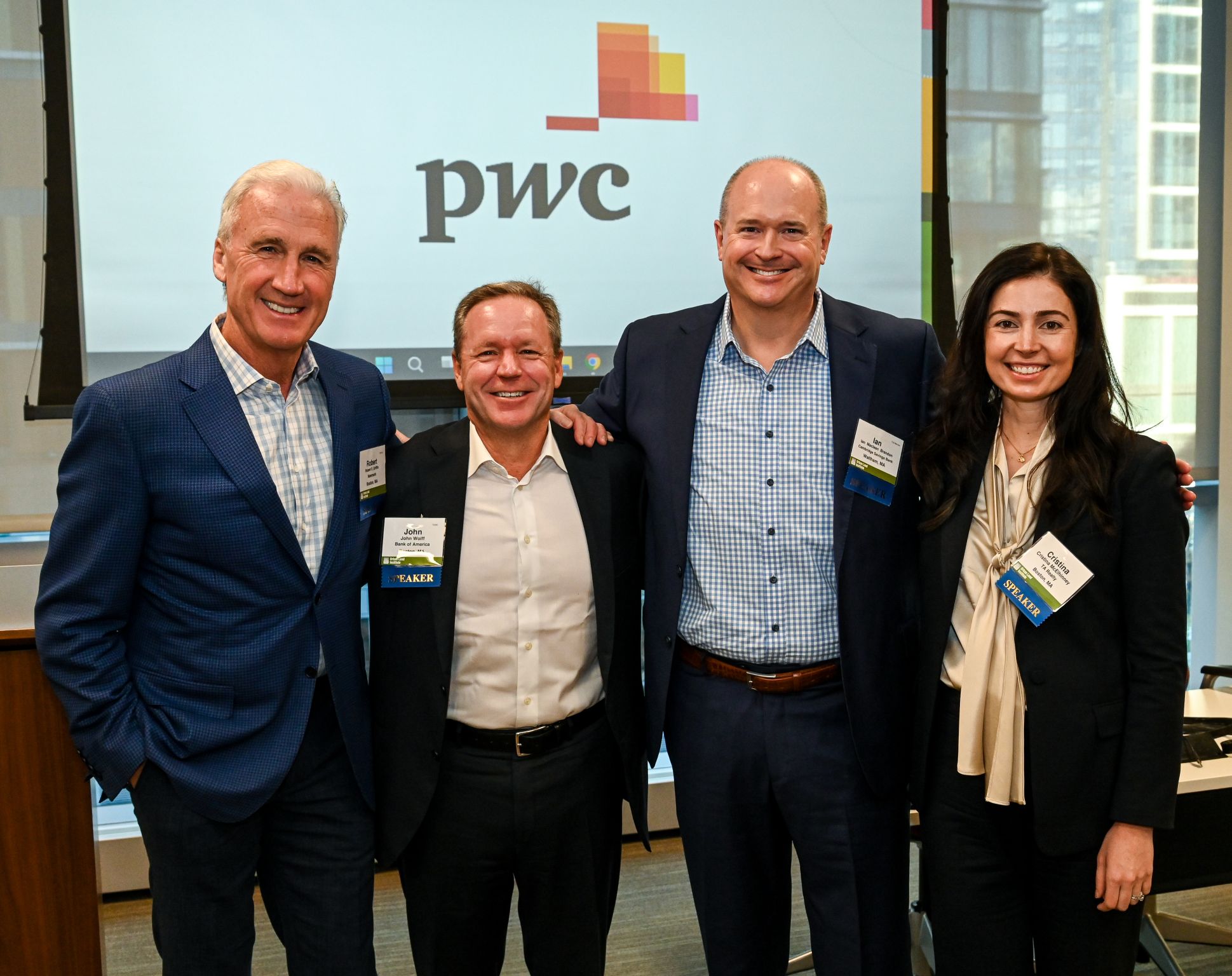
(l-r): Rob Griffin, John Wolff, Ian Brandon, and Cristina McElhinney
Boston, a perennial Top 10 market in the report’s annual ranking, slipped one place from No. 7 to No. 8 on the list of “Markets to Watch.” DiRocco cited Boston’s educated labor pool, access to venture capital, and educational institutions as the region’s strengths while acknowledging the detrimental nature of the area’s high cost of living and doing business.
Griffin led off the panel discussion with an assessment of the capital markets, and while he “sees a tremendous amount of capital back in the system,” there are challenges for investors who anticipated a strong market for distressed properties, which “hasn’t quite materialized,” driving them to seek out alternative investments. He feels that office will see a resurgence as more employers mandate a return to the office for employees (although Boston still lags considerably behind other markets, with a 50% utilization rate). Griffin added that national banks have begun lending again, and also praised Greater Boston’s regional bank system for continuing to lend over the last few challenging years. “Our regional banks are much more embedded in the real estate communities, understand the asset classes better, have been there, and are there again,” he said.
Wolff said that property valuations are one of the biggest challenges for the banking industry right now. “You have the appraisal, you have the (valuation), and then you have reality – and there are big drops as you go down. Our approach has been to work with our clients with office assets and trying to find the right way to monetize those assets on an asset-by-asset basis,” he said. “I think it will be a challenge in 2025 and 2026. It’s a slow burn, and it takes a while to work through the assets.”
On the investment side, McElhinney said that TA is closely tracking inflation and its impact on interest rate cuts but is looking to deploy additional capital in 2025. She sees multifamily as “an attractive buying opportunity…we’re seeing discounts to replacement costs across the board and attractive pricing on a cap rate basis, so going into this year being fully capitalized, able to move quickly and close on deals – all cash – and we think that that will put us in a good position to be able to build a portfolio and build a good basis during the next year.”
Despite the overall optimism of the report and the panel, Brandon believes that the office market will remain a challenge for an extended period, possibly five years, before the basis is reset “(in order) for all of us to have a strong understanding across the market as to exactly what assets are going to be functionally obsolescent.” He acknowledged that while some office buildings will need to be “knocked down to the dirt,” he has seen the number of investors interested in these assets “go up exponentially.”
To read the full report, go to: https://americas.uli.org/emerging-trends-in-real-estate-2025/.