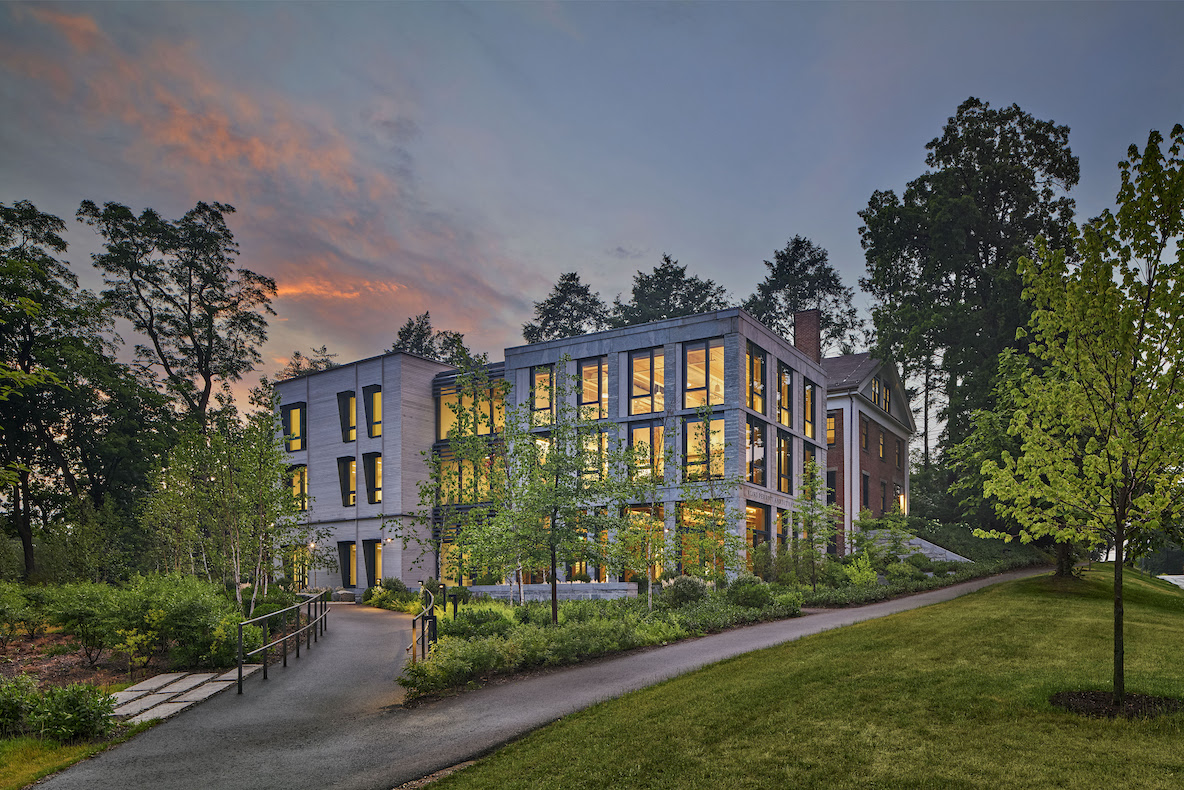
Amherst, MA – Bruner/Cott Architects announced it has completed the new 21,000sf Aliki Perroti & Seth Frank Lyceum at Amherst College.
The lyceum comprises the school’s Center for Humanistic Inquiry (CHI), the Department of History, and communal venues designed to drive discourse and critical thinking. Inspired by the Lyceum of Ancient Athens – a place for philosophical discussions and debate – the building’s spaces are arranged to encourage interaction, collaboration, and conversation among fellows, faculty, students, and the greater college community.
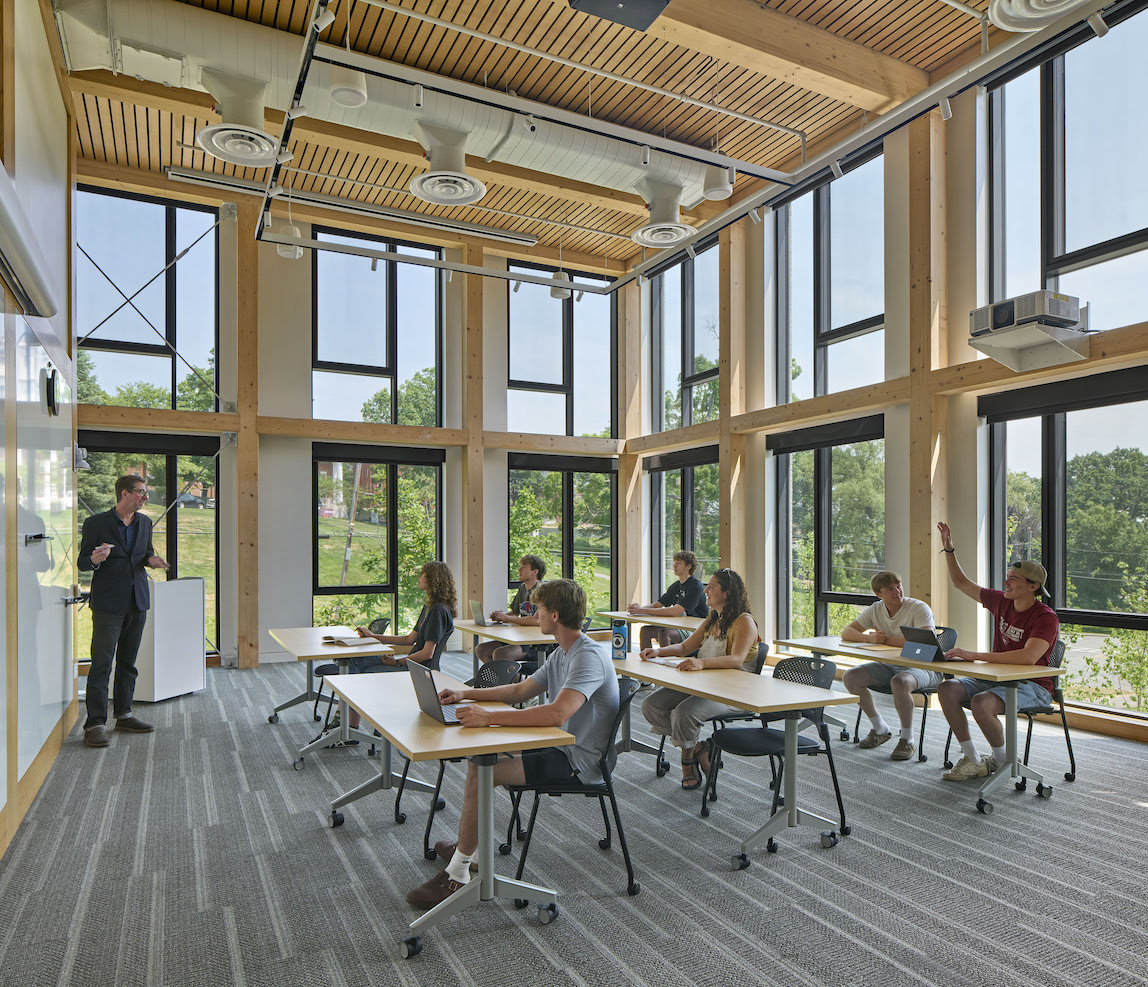
Classroom
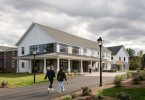
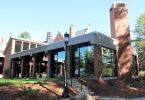
Located on South Pleasant Street, the project is the incubator for a new campus district. It conjoins an extant Greek Revival house with contemporary construction to create a setting for exploring the human condition. The house’s interior was modified to provide a program of offices, classrooms, and support spaces. A new 2-story addition is situated next to the house, separated by a transparent exterior wall. These two volumes contain the project’s large public spaces, an event space, and a flexible classroom. A new 3-story office wing wraps behind the house to create a linear band of offices looking west into the building’s natural setting. Outdoor terraces, along with an open, central commons created by the adjacencies of the lyceum’s offices, classrooms, and ground floor event space, are designed to provide a vibrant place for the community to share thoughts, ideas, and work.
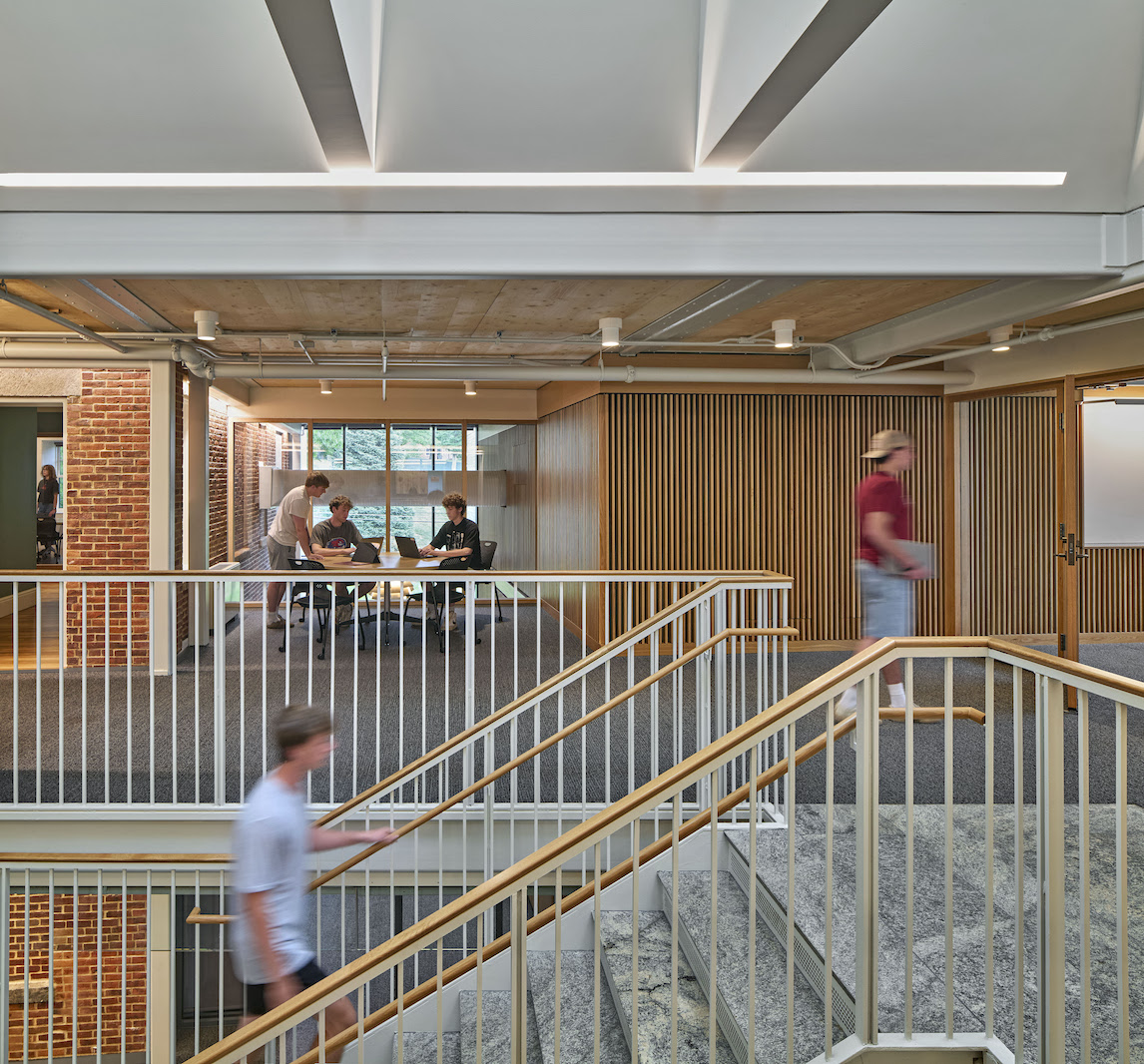
Central interior staircase
Supporting the college’s commitment to carbon neutrality by 2030, the lyceum showcases low-carbon design. Its interior and exterior palettes prioritize materials with low amounts of embodied carbon as well as products that can store carbon, such as wood and other plant-based materials. The building’s envelope is highly insulative and airtight, coupled with all-electric mechanical systems and a 31 kW roof-mounted solar array. The resulting design required an extremely low 69 kg/co2/m2 of embodied carbon to construct the building and is predicted to use only 14.5 kbtu/sf/year of operational carbon. Indoor air quality, operable windows, a daylighting strategy, a verdant landscape, and views of the surrounding environment are additional featured designed to enhance occupant well-being.
“The new lyceum is a place where we’ll gather for dialogue and exchange and to ask difficult questions about what it means to be human,” said President Michael Elliott. “This is the core of what we’ve been doing at Amherst College for over 200 years.”